My friend Annette sent me this amusing video which some of you may not have seen before (sorry about the poor quality but the Hi Def version that Annette sent me wouldn’t load). In fact Central Park is an amazing birding hotspot in Spring and probably one of the best in the North East. I’m just putting together details for a day trip to Central Park as we speak after the success of last year. Details will be out soon on my Trips and Tours page (I just noticed how badly it needs updating).
Conan O’Brien goes Birding
19 03 2009Comments : 2 Comments »
Tags: bird video
Categories : Uncategorized
Northern Saw-whet Owl – Another look!
19 03 2009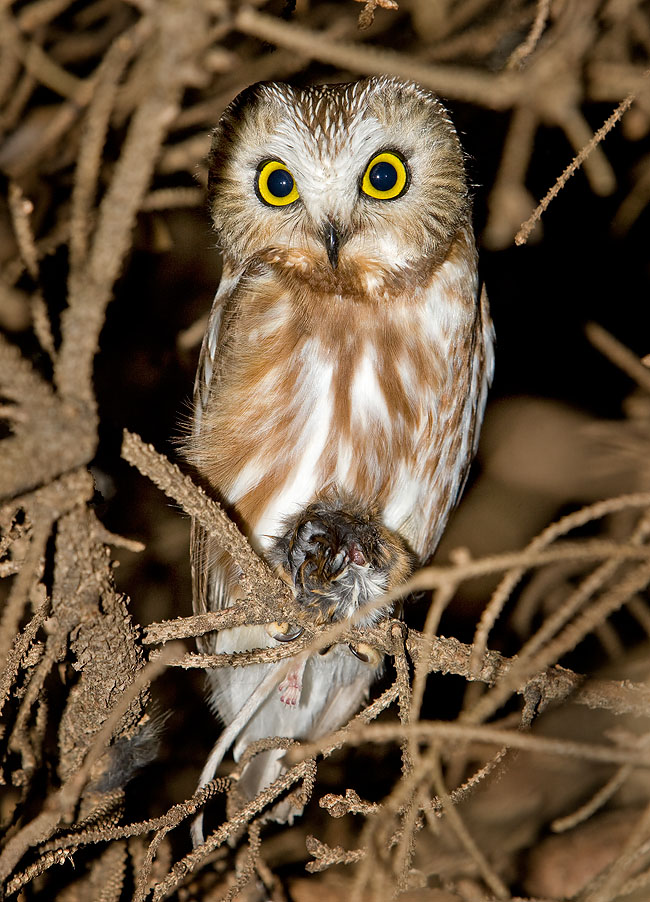
Northern Saw-whet Owl - AJ Hand
The latest bird reports are pretty depressing so I thought I’d cheer everyone up (including myself) with a picture that AJ Hand snapped of the Saw-whet Owl that I found on my Sunrise Bird Walk in Westport over the last weekend (it had left by the next day). I wonder how many of you eagle-eyed birders noticed the little mouse/vole clutched in it’s talons before I mentioned it (you can spot the paw) . I’m guessing the mouse was the only one not thrilled to see this bird at the weekend! Thanks to AJ Hand for the loan of the picture – another really stunning capture.
Comments : 4 Comments »
Tags: aj hand, northern saw-whet owl, Owl, saw-whet owl
Categories : Uncategorized
Bird Reports – Local, National and International
19 03 2009The Audubon Connecticut IBA site has the Conservation Plan for Lighthouse Point Park online. At last weeks NHBC meeting Chris Field talked a little about the plan and some of the decision making that is still to be made. To see the plan online and to answer the feedback form at the bottom of the document, check out the PDF version here.
The Feds have released their 2009 State of the Birds report (here). To me these kind of things always make for some depressing reading, however the positive notes on Bald Eagles, Peregrines and waterfowl does highlight that where there is the will we can make an impact in turning these declines around. A really nice video, with some beautiful footage, accompanies the report as well so check it out.
Spoon-billed Sandpiper report 2009. Things are looking pretty grim for one of the globes most distinctive sandpipers. The latest report shows some pretty diminished numbers from some of the regular wintering grounds of one of the globes rarest shorebirds (more here). A real shame as this is just a stunning bird that captured my attention even as a child flicking through my field guides.
Comments : Leave a Comment »
Tags: bird reports, bird science, conservation
Categories : Uncategorized
Sunrise Bird Walk – March 15
15 03 2009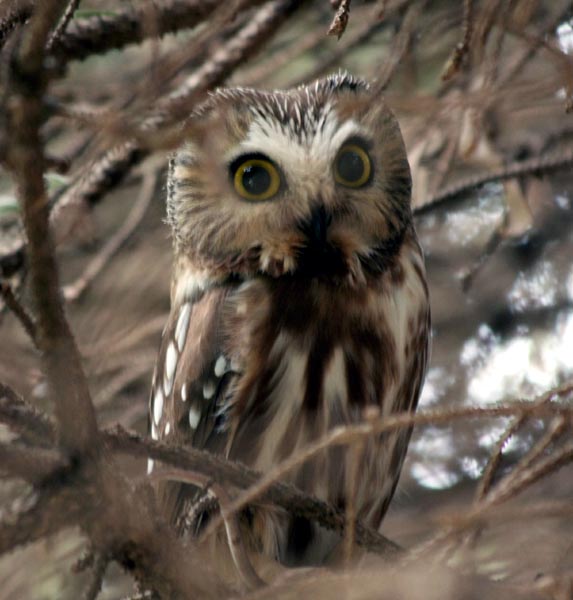
N. Saw-whet Owl - Michael Ferrari
So much for my titling today’s walk ‘Spring Awakening’, apart from a load of raucous blackbirds there was little to make one think of spring and a cool and damp morning wasn’t setting much of a mood either. We started at Grace Salmon Park in Westport but without much sign of egrets or the shorebird or two that I had hoped for. OK there were a couple of Killdeer but it’s a stretch to think of them as shorebirds as they are seemingly just as happy mooching about on gravel parking lots at the Wilton Market as they are anywhere else in the world. The only birds of ‘note’ were some Pine Siskins, but after this year it’s hard to think of them as uncommon within the state.
Next stop was a quick one at Compo Beach where we were surprised by the sheer wealth of waterfowl on show. There were a number of large flocks of Greater Scaup (I pointed out identification of the wing pattern to the group when the birds stretched their wings), hundreds of milling Long-tails and good sized numbers of many other species such as Red-breasted Mergansers, Horned Grebes and Brant. The pick of the gulls loitering offshore was a ‘Kumlien’s’ Iceland Gull which gave the group a good session on identification. Many of the group found the apparent darkness of the primaries surprising for a ‘white-winged’ gull although the name seemed more appropriate with nice flight views. We also went over the theories as to whether the gull is a subspecies or hybrid – answers on a postcard please gull experts. A brief explanation (here), at the present the AOU treats Kumlien’s as as a subspecies of Iceland Gull.
Over at Sherwood Mill Pond the ducks continued to impress with a large mixed Wigeon/Gadwall flock (no sign of the Eurasian). Sherwood Island itself was pretty quiet apart from offshore where a few flotillas of Red-throated Loons and Horned Grebes as well as continuing ducks, many just offshore, were pretty impressive. The cool air and glassy water made viewing conditions almost perfect apart from a little fogginess further out. The only other bird of note a Greater Yellowlegs that certainly appeared to be a recent migrant arriving from the south as it circled the marsh for a while deciding where to put down.
A quick coffee break (at which we added a calling Red Shouldered Hawk – right over Rt 1) and a few more spots and more waterfowl (I wonder if I am the only birder who has fantasized about one day birding the length of Rt 1 on one long crazy road trip – David Sibley meets Jack Kerouac style). Although we’d had some excellent views of some nice birds the tour would have not been the same had it not been for a fortunate spot as we explored a couple of local cedar/pine stands. I spotted a few large splashes of telltale whitewash and as I followed the wash up the branches there was perched a cute little Northern Saw-whet Owl. At 8 inches this really is one super cute little bird. As I’ve said before it’s always a thrill to find these birds and the first flash of those little eyes as you spot them gives one an unbelievable rush. The group all had great looks at what was a life bird for a few involved and a treat for everyone. The group all took turns to have a minute or so with the little beauty and after a few memento shots we left him to his morning snooze.
It’s amazing how one bird can really make a morning out special, so even on the dreariest of days out (not that today was one) I always try to make sure to not let my head drop and keep looking at every bird, as you never know when that great bird might show up. I always remember that finding the Harris’s Sparrow at Allen’s was basically down to a last second change of plan after a disappointing soundwatch at Burying Hill Beach. I almost drove straight past Allen’s on the way home but decided to give it a quick try and make up for the rather fruitless morning. Always worth reminding yourself when you are out that with a little luck the next great bird might be just around the corner (or sat in the next tree!)
Trip Species List: Canada Goose, Brant, Mute Swan, Gadwall, American Wigeon, American Black Duck, Mallard, Greater Scaup, Long-tailed Duck, Bufflehead, Common Goldeneye, Red-breasted Merganser, Hooded Merganser, Red-throated Loon, Common Loon, Horned Grebe, Great Blue Heron, Red-shouldered Hawk, Red-tailed Hawk, Killdeer, Greater Yellowlegs, Bonaparte’s Gull, Ring-billed Gull, Herring Gull, KUMLIEN’S ICELAND GULL, Great Black-backed Gull, Rock Pigeon, Mourning Dove, Monk Parakeet, GREAT-HORNED OWL, NORTHERN SAW-WHET OWL, Red-bellied Woodpecker, Downy Woodpecker, Northern Flicker, Blue Jay, Fish Crow, American Crow, Black-capped Chickadee, Tufted Titmouse, White-Breasted Nuthatch, Carolina Wren, American Robin, European Starling, American Tree Sparrow, White-throated Sparrow, Song Sparrow, Dark-eyed Junco, Northern Cardinal, Red-winged Blackbird, Common Grackle, PINE SISKIN, American Goldfinch, House Sparrow
Comments : Leave a Comment »
Tags: kumlien's gull, northern saw-whet owl, Owl, owls, saw-whet owl, sunrise birding
Categories : Uncategorized
Hand Feeding – Part 2
14 03 2009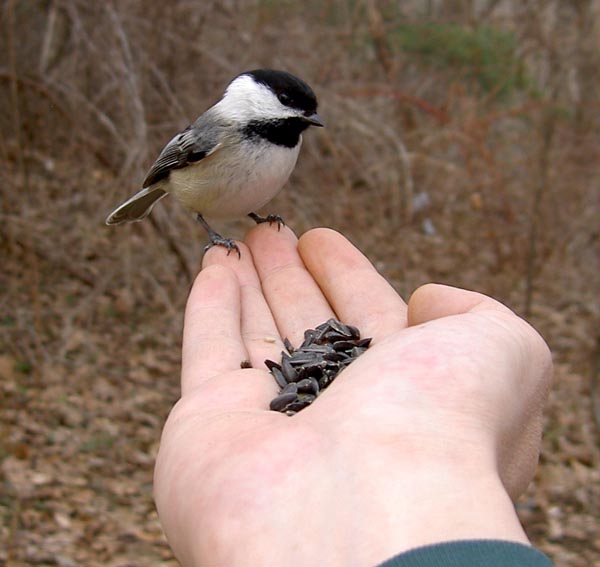
Chickadee - Luke Tiller
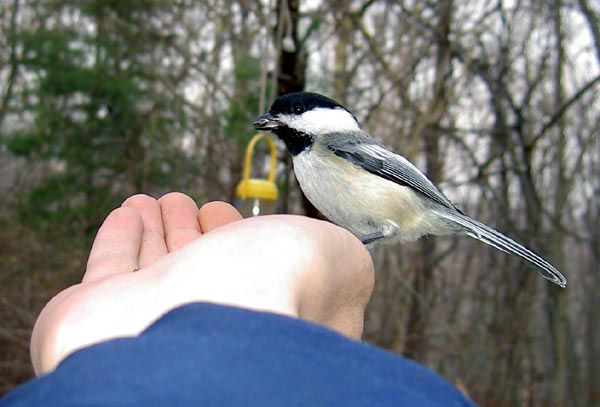
I have been consistently hand feeding the local Chickadees for the last week or so and now get to the point where as soon as I go out into the yard to fill the feeders the birds appear and want to come grab some food from my hand. Today I wondered if I could just use my other hand to snap some shots while they came down to feed. Above and below are the results. A Dr. Doolittle experience if ever there was one.
-
- Chickadee – Luke Tiller
-

- Chickadee – Luke Tiller
-

- Chickadee – Luke Tiller

Comments : Leave a Comment »
Tags: hand feeding birds
Categories : Uncategorized
Birding – a hobby fraught with danger!
13 03 2009My friend Charlie Barnard sent me this crazy set of pictures from a photographers ‘experience’ at Barnegat Lighthouse SP. Good to see the guy seemed to take it all in good humor and it even prompted a little artistic outpouring. Note how important having a cell phone can be whilst out birding – I hope everything heals quickly (more here).
Comments : 4 Comments »
Categories : Uncategorized
Tis the season to go Woodcocking!
13 03 2009Spring is here and the woodcock are already out and about at Allen’s Meadows in Wilton. Thought this cool video from the Bird Chick might be entertaining to see. My personal note would be to pick an evening where the wind is pretty much still, as even a fairly light wind seems to keep the Woodcock from going into full display mode and they just hang out on the ground or chase each other around. I also once read that you need a warm evening over 40 degrees but I think that is more of a guide to when they might first show up. We’ll find out tonight as they are predicting it to only be around 38 degrees.
Comments : Leave a Comment »
Tags: american woodcock, bird behavior, bird video
Categories : Uncategorized
New Bird to science – News from Birdlife International
12 03 2009
White-eyes - Birdlife International
There has been a new bird to science discovered on the Soloman Islands. The Vanikoro White-eye. As with the Galapagos (where I was lucky enough to travel last year with Sunrise) the Soloman archipelago has a host of bird species that have evolved (in this case from white-eyes, in the Galapagos from finches) to fill niches that might otherwise be filled by competitors. You can read much more on this exciting find on the Birdlife International website (here). From the report it appears that white-eyes seem to evolve particularly rapidly to create new species which probably partially explains the numbers of seperate species to be found on the Solomans. Pretty cool.
Comments : Leave a Comment »
Categories : Uncategorized
Sunrise Bird Walk – March 8th
9 03 2009
Northern Pintail - Lionel Stringer
Spring has finally sprung in Connecticut, although it’s been more of a trickle thus far than anything resembling a spring. Last weekend I lead a tour around Fairfield County and we were all pretty happy with a productive day (maybe less happy with the hour change and the early start!). Highlights of the tour were 6 Wilson’s Snipe, including one sat out very nicely on the airfields at Sherwood Island and a group of six which went skittering away with their usual raucous croaks from the ditch alongside the fields. We got into a quick discussion on how to separate Common Snipe (the very closely related Eurasian species) from Wilson’s Snipe (our one) probably the best article I could find online to reinforce this difficult identification process was this article on identification of a Wilson’s Snipe in France which gives some clues on what the differences are (many are somewhat qualitative). From our side of the pond check Martin Reid’s section on Snipe ID on his website.
Other highlights included a regular Lesser Black-backed Gull (which we did a little impromptu ‘workshopping’ on as its telltale yellow legs were firmly tucked beneath this lounging bird), a cracking adult male American Kestrel and a flock of 4 Northern Pintail. Pintails has always been a favorite duck of mine so it’s sad to read how badly they are doing in the US (although this particular year in CT thee have been a good number of them showing up even in decent sized flocks (proof that localized observations aren’t that helpful when trying to give context to bird populations). I note that Ducks Unlimited even have a specific initiative targeting this bird (here), my wife asked if this included not shooting them.In all seriousness though the hunting fraternity here in the US plays a massive role in protecting important habitat that support waterfowl, and as a byproduct any number of other species. Birders are often encouraged to buy duck stamps in order to support land preservation (details here). I do however wonder whether the introduction of a similar ‘Birders Stamp’ might let us gauge the support that birders provide to this preservation process.
Apart from that there appeared to be a few hirundines flying way off inland that I scoped from parking lot but couldn’t be certain of ID they were so many miles away, almost certainly Tree Swallow though. A beautiful day that certainly got me thinking about spring for sure though. Not long now until we have singing warblers and all those goodies streaming back to join us. I spoke to my friend EJ in Louisiana and he is already starting to see stuff that’s on the move. Making me look forward more and more to my first big spring trip in May over to NY State (details here – just a few spaces left). Post walk we went to the unbeatable Blue Bird Cafe in Easton (perhaps I need to update my local birding map with my favorite diners!). From there I was kidnapped and taken to go find the Cackling Goose that Charlie Barnard ad spotted at Trap Falls reservoir. I relocated it on the far side of the reservoir and although views were distant one could make out the stubby bill and the very boxlike head of the Richardson’s subspecies. Steep forehead, almost flat top to the head. The bird was generally very light and the upperparts silvery but one has to be careful reading too much into this due to the harsh light (Cackling Goose ID Tips). Nice bird though and probably a good addition to the boys Stratford Big Year. A great day out with a nice group of birders and 60 degree temperatures- can’t complain about that in March!
Trip Species List:
Horned Grebe, Common Loon, Red-throated Loon, Mute Swan, Canada Goose, CACKLING GOOSE (with some of group at Trap Falls), Brant, Mallard, American Black Duck, American Wigeon, Gadwall, Green-winged Teal (TF), NORTHERN PINTAIL, Ring-necked Duck, Bufflehead, Ruddy Duck (TF), Hooded Merganser, Red-breasted Merganser, Common Merganser, Long-tailed Duck, Turkey Vulture, Red-tailed Hawk, AMERICAN KESTREL, Killdeer, Ruddy Turnstone, WILSON’S SNIPE, Wild Turkey, Herring Gull, Great Black-backed Gull, Ring-billed Gull, LESSER BLACK-BACKED GULL, Rock Pigeon, Mourning Dove, Downy Woodpecker, Black-capped Chickadee, Tufted Titmouse, American Robin, Blue Jay, Fish Crow, American Crow, Yellow-rumped Warbler, White-throated Sparrow, Song Sparrow, Common Grackle, Red-winged Blackbird, Brown-headed Cowbird, American Goldfinch, European Starling, House Sparrow
Comments : 1 Comment »
Tags: sunrise birding
Categories : Uncategorized
Pretty quiet – well bird wise at least!
6 03 2009
Blurry Chickadee in Hand - Toni Tiller
Well this week has been a pretty quiet one for me on the blog and out in the field wise. Just had too much to do working out the details of a whole load of exciting trips for the next year amongst other things. Apart from popping out into the yard to fill the feeders there hasn’t been any chance to do any birding. I still have Pine Siskins around of course, probably 20 or 30 of the little cuties. It really has been the year of the Siskin with unbelievable numbers of them showing up at the hawk watches earlier in the season including days at Lighthouse Point with 2000+ birds. If you haven’t ever looked at Hawk Count it’s a great website with daily updates when watches are in progress and lots of interesting data in monthly and yearly summaries, how to get to the sites etc etc (see here).
Interesting to note that although there was a heavy fall movement there were only a couple of Christmas Bird Counts where Pine Siskins put in a significant appearance in Connecticut (see data here) however by January they seemed to be everywhere again. Recently on Massbird there was a post saying that we should be looking for these birds showing signs of breeding. Apparently in these irruption years they often hang on to breed (fairly early in the year) further south than they would regularly be occurring. This made me hazily recall having Pine Siskins hanging around the SoNo Reservoir’s pine stands in late May or early June one year and I remembered wondering about possible breeding. Just a reminder that one needs to make better notes on stuff like this as I can’t for the life of me remember the right year let alone the exact month.
It has been interesting to keep track of the Pine Siskins this year and two things I have particularly noted are, the amazing variation in individual birds and the change in the vocalizations throughout the winter. Obviously with plumage some is influenced by the age and sex of the birds but the heaviness of streaking seems to be highly variable, with birds that look almost black-breasted, so dense are the streaks, to birds with just a couple of light diffuse streaks on the upper breast and flanks. This variation also seems to show up in other ways and there has been note of rare ‘green morph’ birds on CTbirds. The Stokes blog has some great pictures of a green morph (here) but I have noted that there is a deal of variation in the mantle colors of individual Siskins with many that seem to show a green back (although I have not seen one that shows such a deep yellow wash on the underside as in this picture.)
As far as their vocalizations, at first I was mainly picking these birds up in flight in fall through their simple flight calls, the ‘kleeyu’ call being particularly helpful as an ID until you got used to the difference in tonality with Goldfinch. These simple flight calls appeared to dominate vocalizations for most of the winter. However, by mid to late February I started to note that their calls seemed to be becoming much more complex around the feeders with some definite ‘singing’ going on. Today was different though and was the first time I spotted one doing one of those goldfinch-like display flights in which they fly in loops around and around a little area (this time my yard) singing as they go – a pretty cool little exhibition. Anyway this year I’ll keep my eye’s open for more possible breeding behavior (carrying nest material, food carrying etc) and make sure to keep proper notes on it this time. I have made a little vow to make sure I stick all of these sightings on eBird as well from now on (eBird).
Just for fun today, as the feeders were empty this morning, I decided to see if I could lure some Chickadees down for a spot of hand feeding and for the first time in my life it actually worked! Pretty neat to have these little birds come land on your hand to grab a sunflower. I wondered if it was just because they were used to me filling the feeder that they trusted me enough to come in to land (I assume it was different birds some times although it might just have been the one hungry/brave one) but I quickly dispelled that idea by letting my wife have a go (which she did successfully). Anyway, a cool little experience feeling those little chickadee feet gripping your fingers as they grab a snack (talk about getting in ‘touch’ with nature). A couple of times they just sat there fairly nonchalantly for a while before moving on to crack open the seed. My wife took the above photo – not very good I’m afraid – I’m sure we’ll try again tomorrow.
Give it a go if you haven’t tried it before. To me, as a novice at this, the key seems to be a) have empty feeders – I doubt they’ll come to you if safer options seem available b) stand close to a safe perch that they can tee up on while they decide whether to come check out the food c) don’t look directly at the birds as they come in – this seems to scare them d) prepare for tired arms – it seems to work best if you hold your hand flat out so they can see the seed and you’ll need to hold your arm outstretched well away from your body. There are a few sites on the web that have suggestions of how to take a more systematic approach to this (here’s one) but I personally am not very good with delayed gratification so I was pleased it worked straight off .
Comments : 1 Comment »
Tags: hand feeding birds, siskins
Categories : Uncategorized
 Under Clear Skies