Bigby – Bigger & Better – Pelicans!

12 04 2011

A. White Pelican - Luke Tiller

The last couple of day have been pretty incredible, so it’s very hard to know where to start first with the blog posts! I guess I’ll space them out a bit, otherwise I’ll be spending the next 5 hours writing blog posts and I still have taxes to go stick in the post. After an incredible day was winding down at the hawkwatch, which included almost 9,000 raptors, I was lucky enough to spot a pair of American White Pelicans cruising over Braddock Bay towards the West Spit area. Amusingly Josh Lawrey (who was helping out today) has an amusing story about White Pelicans at Braddock Bay, so when I called them out he initially thought I was trying to wind him up!

Sure enough though the pelicans were real though and not part of a rather corny old joke. After a while drifting about the bay area they eventually were followed as far as the eye could see and seemed to disappear over towards Salmon Creek on Manitou Rd, where they were eventually relocated loafing around in the shallow water there by some of the local birding community. This gave a good number of people the chance to drop in to see these birds, and also gave me the opportunity to drive home after work and walk the mile and a half to add these to my Bigby list just before sunset. This has to be the best sighting so far on the Bigby year so far – easily eclipsing the Barrow’s and the Snowy Owl (you can see the full list on the Bigby page).

As spring begins to break here at Braddock, I have managed to pick up a few migrant birds each morning and today I finally broke through the hundred barrier. The Bigby birding gods must have been with me this morning though as I broke through 100 birds in some style. Perhaps it was birding karma for popping out early to check and see if the pelicans had over-nighted at Salmon Creek (they had) in order to get a message on Genesee Birds to let people know they were still out there. As I pulled back into the drive this morning after checking the pelicans, I heard the distinctive grunt of Sandhill Cranes and low and behold there were two of them drifting over my head and out towards the lake – a great Bigby score!

I popped in and posted that the pelicans were hanging in at the creek and made myself the cuppa that I never quite managed the morning before, more on that story later, before popping out on the deck to drink it. The decision to go en plein air for the tea was an inspired one. As I stepped outside the racket that the blackbirds and starlings usually make cranked up about 100 decibels, and to my surprise a beautiful, crisply marked juvie Northern Goshawk muscled his way in and perched at the top of the tree right outside my house – simply incredible! A half hour into my morning and I had already spotted 2 pelicans, 2 cranes and a Northern Goshawk, that just gives you some idea of how good the birding at Braddock Bay can be!

I wasn’t finished with the excitement for the day, and still have to jot down some thoughts on yesterdays incredible hawkwatch, but for now those experiences can wait – time for another cuppa and to pop out and see what else I can find for my Bigby list!



Who hates ducks?

7 04 2011

Oldsquaw - Luke Tiller

Out on Lake Ontario as well as getting to see some cool birds I am also getting to see some cool plumages. Back in Connecticut I have never knowingly seen an adult male breeding plumaged Long-tailed Duck. Here they are  dotted around amongst the birds that are still in basic plumage. Hard to believe that those stunning Long-tails in their mainly white finery are actually in their dowdy non-breeding garb. The other day I said that I sometimes joke about hating ducks. I definitely don’t hate Oldsquaw (or Long-tailed Duck to give them their politically correct but less characterful new name) in either their winter or summer finery. It’s just hard to decide which of the two is prettier!


Saw-whet musings etc…

6 04 2011

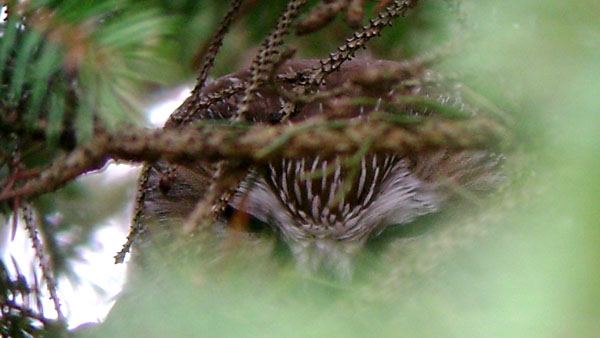
Saw-whet Owl - Luke Tiller

It was a slow day at the hawkwatch, after a bright warm start the clouds settled in, the air cooled and it robbed me of any afternoon flight. I decided to cut my losses and head home and save my energy for tomorrow. Still it was pretty early in the day, so I decided to go and have a wander around some local spots and see what, if anything, I could add to my Big Green Big Year list (here).

Over at the hawkwatch I had managed to pick up my first Blue-winged Teal of the season (about 4 drakes and two hens) and I thought I might be able to pick up others on the Manitou Beach Road side of the bay.  No joy, and I still haven’t even managed to get Green-winged out this side of the bay yet either – perhaps Teal will be my bogey duck? The hike down to Breakers could have been a complete wash were it not for happening upon a Caspian Tern that was cruising up the creek. Still with that and the Red-throated Loon from Ontario Beach Rd I am at least steadily accumulating for the season, and I am up to Two Fat Ladies as they say in bingo (88).

As I was right there already, I decided it was at least worth a little wander through Owl Woods to see what I could find there. A Long-eared would be nice – I think it’s time to give up on the dreams of finding a Boreal 😉 No Long-eareds today but Saw-whets were again easy to find. I tried to get a couple of digiscoped shots with my recently returned Swarovski Scope, not exactly Nat Geo material but a visual memory of the occasion at least.

I have noticed that things have gotten kind of heated about some of the goings on at Owl Woods recently and it was nice to see that BBRR have posted some guidelines about both looking for and photographing owls. Out of interest he ABA birding ethics guidelines can be found here (note the constant reference to the best interests of the bird!) I spend most of my year in Connecticut, and the listserve there has outright banned the posting of nocturnal owl sightings due to questionable birder and photographer behavior. It leads to something of difficult situation whereby beginners who are not very experienced at looking for owls get frustrated by the fact that they don’t  get them reported. Anyway, it makes me more aware of how lucky local birders are up here in Rochester that these birds get posted to the listserve.

That said I don’t believe there is a right to know about bird sightings and the more thoughtless behavior that birders observe at Owl Woods, the less likely I imagine they are to share their sightings. Although it can be difficult, I think it’s really incumbent on people to say something (politely) if they see things that they believe are overstepping the mark (moving or even removing branches for better shots of the birds is pretty obviously not on!). It’s possible that people just aren’t aware of the stresses they are placing on the birds, so if you say something do think carefully about how to say it tactfully.


Saw-whet Owl - Luke Tiller

Today I managed to fairly easily find two Saw-whets at the woods. In both of these shots I was digiscoping the birds from a fair distance, but as you can see they are aware of my presence. Once I found them I backed off to a distance to let them settle back down and even avoided going to search through another set of trees, as I would have had to squeeze past one of these birds. I took a couple of shots and was out of their vicinity within a minute or two. It’s always such a great experience to see an owl, but I strongly believe it’s incumbent on us to make sure that we don’t disturb them while we enjoy them.  Owl Woods is a really magical place, I hope it stays that way and that people continue to feel comfortable sharing their sightings from these amazingly productive little woods.

Just because my owl pictures are so amateur, I thought I’d share one my friend AJ took in Westport CT which he loaned me for my blog before (here). He actually didn’t like this shot very much – shows you how good his best ones are!!!! You can find more of his owl (and other bird) pictures from Sherwood Island in the links on the side of the page. You can also read about the time I went owl banding (here) and see some of the great sketches my friend Birdspot produced from the trip (here).


Bigby Snowy Owl

1 04 2011

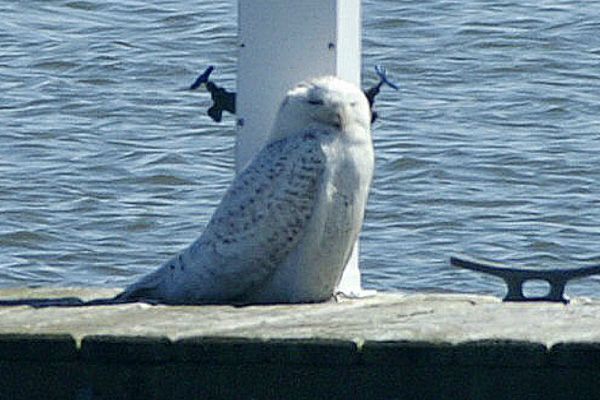
Snowy Owl - Ed Sailer

My first twitch of the season! When I heard that there was Snowy Owl hanging out on the docks by the old Breakers Restaurant off of Manitou Beach Road, just half a mile from the house, I could hardly not go. As I have said before on this blog, twitching is not really for me, but I wasn’t going to not go see a Snowy Owl just ten minutes walk from the house. After I stopped in to see the bird on the way home, I drove back to the house before hiking back over to see the guy all over again for my Big Green Big Year. Probably the second rarest bird seen so far this year after the Barrow’s Goldeneye, but to most people a little more exciting! Friends of mine sometimes pull my leg for the time I told everyone that  I hate ducks 😉

From here on anything I say in this post that is complete and utter rubbish is completely and utterly my fault for misinterpreting what Tom said.

After a few people had put out phone calls to get people to see the bird, one of the local Braddock Bay Raptor Research banders, Tom McDonald, took a shot at recapturing this bird (he’d actually caught it earlier in the season). Whilst we waited to see if the owl would take the bait, I got to talk to Tom about Snowy Owls and banders. There isn’t much Tom doesn’t know about Snowies, having caught and banded many hundreds over the years, probably as many as any bander in the US (or even the world?). He’s currently working on a book all about the birds and I was lucky enough to see some of the plates that he was working on – looks like it’ll be a pretty cool tome.

So with  Tom cornered whilst we waited to see if the bird would take the trap bait, I finally got an answer to the one question that has always flummoxed me when it came to Snowy Owls. I remember being told by a number of birders that the Snowy Owls that we would see in Connecticut each winter were basically birds that had been pushed a long way from their usual territory, were in poor shape and likely to never make the return journey to the Arctic to breed but rather end their days dying emaciated in those ‘southerly’ climes.

I have often wondered whether this rather tragic view of these individuals is one of the reasons people seem to get so fired up about anyone (read photographers) putting pressure  on birds when they show up in the state. After all Snowy Owls are pretty much  just as happy being active diurnally as they are nocturnally, unlike the other owls that get equally harassed by photographers and birders who seem to have never even heard of the ABA code of ethics. Now not that I want to give photographers a pass on crummy behavior, but in talking to Tom this image of the doomed Snowy seems to be a common but incorrect assumption of these wandering individuals. Personally it never really made sense to me that an emaciated bird that was struggling to find food would even make it down as far as Connecticut if it really was starving. Why travel all that way to die, when traveling takes energy!

It seemed only logical to me that there must be a successful strategy being worked on for the birds to head all that way to Southern New England.  Just to make it that far requires a heap load of energy, so they must be doing something right along the way. Also when I have had time to spend some time with some of these individual roaming Snowies, like the bird at Piermont Pier (which was hanging out with and providing scraps for the Ivory Gull), or the one from Norwalk – which pretty much kicked off this blog (here) they seemed to be hunting very successfully thank you very much.

Tom says that his banding studies reflect this state of affairs as well, and that he has very rarely trapped emaciated birds around Rochester. All raptors can struggle to find food, but most of the birds he finds are rather in rude health like the bird in the shot above (Any birding chums want to take a shot at aging and sexing the bird?) which weighed in at over 1600 grams.  In fact birds that are found to be starving are usually young birds that never really seem to make it that far from the nesting site, not the ones that have traveled a long way.

Talking to Tom it’s easy to understand his awe for these birds, the passion and reverence that he obviously has for them. They are incredibly successful hunters that take a variety of prey and this particular bird was sitting by the remains of a number of carcasses including a Ring-billed Gull, and Tom told me that he has known them take a swipe at something as large as a Canada Goose. He also talked about his many adventures chasing round looking for them on their breeding grounds or simply sitting quietly ,studying their amazing interactions and hunting techniques with a nightvision scope!

Anyway it is good to know that these birds that one sometimes hears (from generally reliable sources) are doomed are rather not quite as doomed as commonly suggested, but are almost certainly following a tried and tested migratory pattern to get through the winter season. It was amazing to talk to Tom about the birds as it’s always a treat to converse with someone who really knows so much and is so passionate about an individual species, and individual species don’t come much more exciting and inspiring than a Snowy Owl. Thanks also to Edward Sailer for the pictures.


Bird Music – Indie Mixtape

31 03 2011

RT Hummingbird - Luke Tiller

I have been messing around with the playlists function on youtube and have finally nailed what I think is a pretty decent indie/alternative bird related music setlist. Hope you enjoy it:  http://www.youtube.com/p/AA119E9311CC651A?hl=en_US&fs=1

Track List: 1/ Eels – Little Bird 2/ Grant Lee Buffalo – Mockingbirds 3/ Iron and Wine – Flightless Bird, American Mouth 4/ The Bird and the Bee – Please Don’t Stop the Music 5/ Goldfrapp – Little Bird (Animal Collective Remix) 6/ Catbird – Yellow Moon 7/ Sun Kil Moon – Heron Blue 8/ Electrelane – Birds 9/ Foals – Hummer 10/ The Decemberists – Crane Wife Three 11/ De Rosa – Robin Song 12/ TV On the Radio – Owl and Stork 13/ Fleet Foxes – Meadowlarks 14/ The Tallest Man on Earth – Where do my Bluebirds Fly? 15/ Swans – Love Will Tear Us Apart


Eurasian Wigeon – Braddock Bay

19 03 2011

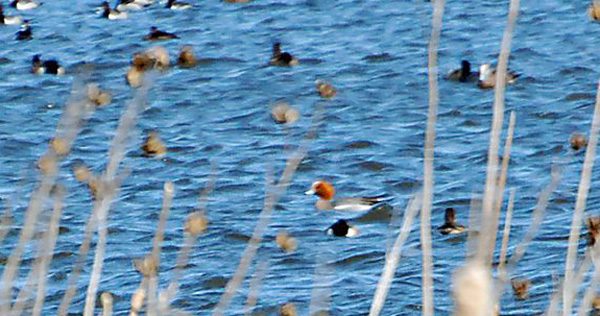
Eurasian Wigeon - Art Tanghe

Another new species to add to the growing list of ducks I’ve seen over the almost month I have been here. Probably only he second rarity as well. It’s amazing how abundant species that would be considered uncommon or even rare when you get as far east as Connecticut can be here. Tundra Swans are an very day occurrence, flights of Snow Geese regular, numbers of Shoveler, Pintail and Redhead nothing to get too excited about. What was most interesting to me was seeing Horned Grebes sitting right up by the mouth of the creek yesterday instead of way off on the open lake or at least even at the mouth of the bay. One of the few times I’ve had point blank views of Horned Grebes with just bins.

Thanks to Art Tanghe for both finding the bird and sending me a visual memory of the bird and letting me borrow that memory to illustrate the blog. Terrible conditions for photography and the bird was some distance out in the haze but it’s a nice record. Out of interest I wonder whether anyone in the US has ever had a female type Eurasian Wigeon record accepted? I don’t recall any off the top of my head in Connecticut.

This evening I popped out to listen for displaying Woodcock and was intrigued to spot a Great Horned Owl on the far side of the field where the Woodcock were displaying. I think we were both there to listen for owls but its reason for doing so was slightly more sinister than mine. I remember seeing a Great Horned Owl  carrying a Woodcock at Allen’s Meadows and became aware that the Great Horned Owls that nest nearby must make this a regular part of their diet as they would often show up at that time of year. I just hope they don’t try and swallow that Woodcock bill and all – could make for an interesting pellet!


Owl Woods – the name finally seems appropriate!

13 03 2011


Saw-whet – Luke Tiller

So finally after almost three weeks in Hilton, Owl Woods finally gives up the goods. Yesterday there were rumors of two Saw-whets and two Long-eareds at the woods. Unfortunately I couldn’t find any of them on the way home. Not that it really mattered as I hadn’t hiked out there so it would have done nothing for my all important Bigby list.

Anyway today at the hawkwatch a couple of well known local birders showed up and said that there were Saw-whets there again today and gave me a couple of pointers on where to try. Anyway to cut a long story short ,after just a few minutes searching I had one. The bird was snoozing peacefully in a rather dark and well camouflaged spot. I decided the best thing to do was leave him to get on with it, as it was not a bird remotely conducive to photography and I didn’t ant to disturb the little guy – so above is what he might have looked like had he been in a better spot 😉

As well as the owl I managed to pick up another handful of goodies for my Bigby including a dozen or so flyover Snow Geese and Ring-necked Ducks (in good numbers on the bay). Yesterday, I added a couple of flyover Great Blue Herons and a Bald Eagle that was out on the Island Woods. Passerines are still very thin on the ground, but I imagine that they are on their way. I have set out some bird seed out just in case. Hmmm, I wonder if it is worth having a wander outside for Woodcock tonight – might be a little cold, but a the SAS motto says ‘Who Dares Wins’.

Bigby total thus far: 68 Species (Perhaps I should set up a separate page for that list)?


Golden Day at the Hawkwatch

11 03 2011

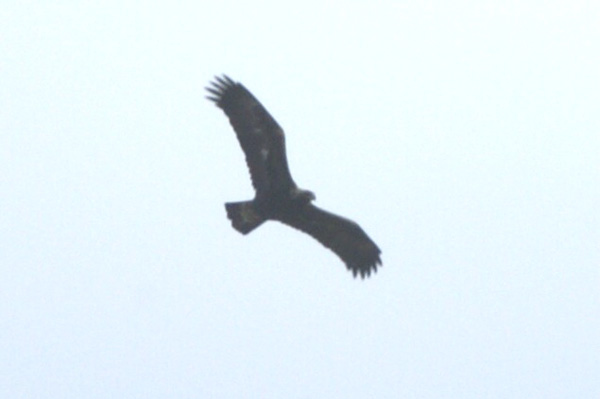
Golden Eagle - Ed Sailer

I was pleased to get the first decent flight day at Braddock Bay Hawkwatch. After a so-so start, things picked up mid morning and as the throngs of local hawk aficionados gathered we were treated to a pretty good mid-morning flight. The birds were pretty haphazardly strewn across the sky, but there were plenty of birds that put on a good showing including the above Golden Eagle which came straight over the park. Unfortunately lighting conditions weren’t great but you can certainly get the idea from Ed’s shot.

As well as 100 raptors we were also treated to about 600 Snow Geese amongst the many thousands of Canada Geese, and I was pleased to find my first flyover Bluebird of the season. I would have liked to have seen the Evening Grosbeak that someone had flying over Owl Woods this morning (still no owls there it seems). I guess you can’t have everything!

Is it just me or is aging of Golden Eagles somewhat difficult, especially in spring. I’d be interested on any thoughts on this bird although there may not be enough detail in the shot?

EDIT: I should mention two excellent articles on the challenge of aging Golden Eagles by Jerry Liguori one on Utah Birds (here)  and one one from the ABA Birding Magazine (here).


Bigby Bonanza

6 03 2011

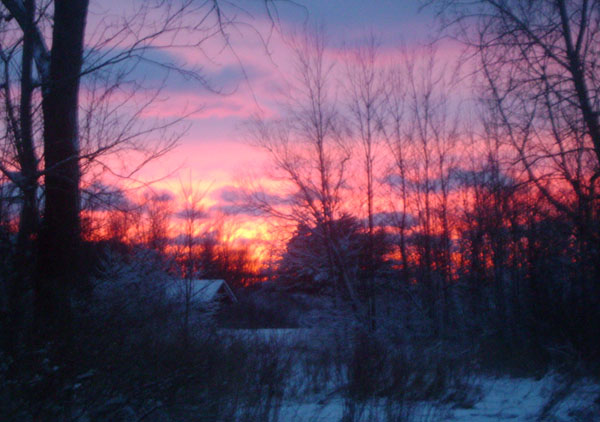
Sundown in Hilton


I wandered out to the West Spit again today in the late afternoon after a rather heavy snowstorm had scuppered the days hawkwatching. Ducks were literally littering the bay, with numbers of both individuals and species rather impressive.

The usual hordes of Oldsquaw (LT Duck) were up to at least 400 birds and the ever present Greater Scaup flock seems to have grown to easily over a thousand. All in all 13 species of duck on the pond including a few new birds for the Bigby list: Northern Shoveler (12) and Ruddy Duck (1). There was also a couple of American Coots to boost the new Bigby species for the day to three and the years total up to 62.

No sign of the Snowy Owl or anything interesting amongst the 1000 plus gulls. Still lots of great birds and it was just enjoyable (if cold) scanning through the throngs of waterfowl, and I’m still not tired of seeing Tundra Swans on a daily basis.

The Bigby Map so far (here).


Back to the Bigby

4 03 2011

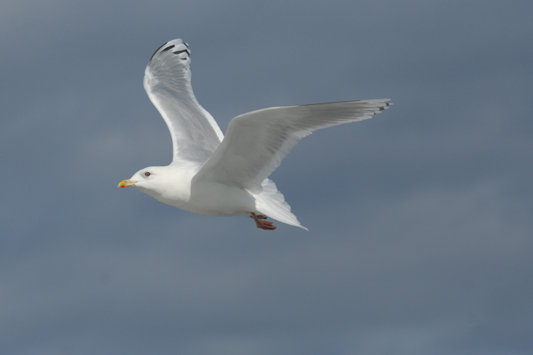
Kumlien's Gull

A couple of years I stumbled upon the idea of doing a Big Green Big Year. The basic premise being to find as many birds as one can whilst traveling under ones own steam or by using public transport. It struck me as a cool idea. The main appeal is that it encourages birding locally, looking for ones own birds as well as doing a little bit for the planet as well

It has always somewhat bothered me that most birding ‘competitions’ always seem to involve burning a huge amount of fossil fuels, which has always struck me as a little incongruous in a hobby that has close links to conservation. I can’t say I am a huge fan of the ‘big year-ization’ of birding either, and that twitching has become the predominant form of the game. Not to knock those that are into it, but it just doesn’t fire me personally.

For me the thing I enjoy most about birding is just getting out and finding out what is around even in the most unlikely of spots, I like to stay local (unless I am really traveling) and I like to find my own birds. A Big Green Big Year seemed pretty much perfect in this respect as it’ll allow me to concentrate on what is around locally and I imagine there won’t be too many birds I can walk (or cycle to later in the season) to twitch so I’ll be forced to find my own goodies.

Obviously being in a great location for birds is going to help make the undertaking more enjoyable and as I now find myself in a spot where I can hear Long-tailed Ducks honking  from my yard, I thought it would be fun to restart the project and see just how many species I can dig up over the year from my two bases around the country.

After a couple of slow days (I haven’t even seen a Junco, passerines are so thin on the ground in Hilton) things got on a roll on Wednesday when I managed to dig out a couple of decent birds from Braddock Bay (which I can view from the West Spit just a stones thrown from the house). The highlights were 30 Tundra Swans and the first decent self found bird of the Bigby, a handsome drake Barrow’s Goldeneye.

I popped back Thursday to see if I could locate the Barrow’s but with no joy and ran into a couple of other birders who had struck out as well (Dave Tetlow and Curt). I couldn’t find the Lesser Black-Backed Gull that Dave had spotted earlier but did manage to find a third cycle Glaucous Gull which was another highlight addition to the Bigby list.

Looking forward to seeing just how many species I can manage to round up. Just disappointed at the moment that Braddock Bay is wide enough that I can’t make out the shrike that is still hanging around the hawkwatch across the bay 😉

Bigby List: 59 species (including some from Audubon Greenwich). Highlights in bold.

Mute Swan, Tundra Swan, Canada Goose, Mallard, American Black  Duck, Gadwall, American Wigeon, Northern Shoveler, Canvasback, Redhead, Greater Scaup, White-Winged Scoter, Long-Tailed Duck, Barrow’s Goldeneye, Common Goldeneye, Bufflehead, Common Merganser, Red-breasted Merganser, Hooded Merganser, Turkey Vulture, Black Vulture, Sharp-Shinned Hawk, Coopers Hawk, Red-tailed Hawk, Ring-Billed Gull, Herring Gull, Glaucous Gull, Iceland Gull, Great black-backed Gull, Mourning Dove, Great Horned Owl, Red-Bellied Woodpecker, Northern Flicker, Downy Woodpecker, Hairy Woodpecker, Pileated Woodpecker, Blue Jay, American Crow, Tufted Titmouse, Black-capped Chickadee, White-breasted Nuthatch, Carolina Wren, American Robin, Northern Mockingbird, European Starling, American Tree Sparrow, Fox Sparrow, Song Sparrow, White-throated Sparrow, Dark-eyed Junco, Snow Bunting, Northern Cardinal, Red-Winged Blackbird, Common Grackle, House Finch, American Goldfinch, Common Redpoll, House Sparrow