There’s never much around in the world of comedy relating to birds, so it’s always nice to dig something out bird related that makes me chuckle. For those that don’t know the League of Gentlemen it’s a British comedy show that has one character that is a rather luckless vet – Mr Chinnery. The sketch is also a nod to a great British movie called Kes about a young working class boy and his pet Eurasian Kestrel. The movie is absolutely fantastic equal parts charming, moving and hilariously funny with many classic scenes that will ring true – especially for anyone who has ever suffered an oafish gym teacher.
Bird Comedy!
11 03 2010Comments : Leave a Comment »
Tags: bird comedy, bird video, comedy
Categories : Uncategorized
Spark Bird – Cedar Waxwing
8 03 2010

Cedar Waxwing - Luke Tiller
Everyone seems to have a ‘spark’ bird, something that grabbed their attention so much that on reflection they realize that it was at that point that they had embarked on the road to becoming an avid birder. So here’s my ‘spark’ bird. It was March 2003 and I was merrily feeding the birds in my yard with my new feeder setup when a flock of Cedar Waxwings suddenly showed up and started scarfing down the multiflora rose berries tangled in my apple tree. It was then that I realized that I needed to start spreading my wings and heading further afield to track down birds. This week the waxwings were around in my new yard in Greenwich (see picture above) feasting on privet berries. Not as noteworthy as their ‘Bohemian’ cousins but as pretty and up there with my favorite common Connecticut birds.
Comments : 2 Comments »
Categories : Uncategorized
Ghost Bird in Greenwich
4 03 2010
Albino Red-tailed Hawk - Jennifer Braverman
Here’s a cool picture of an albino Red-tailed Hawk that was taken here in Greenwich. Thanks to Jennifer Braverman for sending in the photo and for giving me permission to use the image. She relayed to me that it didn’t seem keen to pose for photos, but I think the snap gives a pretty good idea of just how white this particular bird is. A pretty incredible looking individual. Anyway nice to add to the albino bird collection on the blog (see the Double-crested Cormorant pictures here).
Comments : 1 Comment »
Categories : Uncategorized
Bringing It All Back Home
2 03 2010
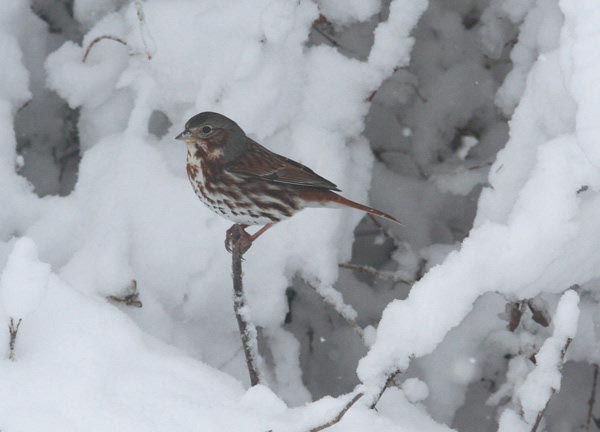
Fox Sparrow - Luke Tiller
Just when I thought winter was likely to be over, Greenwich Connecticut (in fact perhaps only Riversville Rd Greenwich CT from what I could see when I finally got outside!) gets whacked with the toughest storm of the year: 10-12 inches of snow, power cuts, downed trees and loss of internet access (shock horror!) What to do what to do? Well if you are like me you move your office to the rear window and spend the day watching your bird feeders and going a little stir crazy. As much as I love seeing rare and exotic birds, fussing over the intricacies of gull identification (cough!) and getting out and about on tour there is much to be said for the simple pleasures of just watching the birds doing their thing in your yard.
Some birders I know object to the idea of feeding birds, or are at best ambivalent to it and suggest that feeder setups just encourage the spread of disease and encourage accidents associated with window strikes and such. Personally the world of feeders and feeder birds dragged me back into the world of birding and I think it is an entry point for many of us – just look how popular the Great Backyard Bird Count or Project FeederWatch are. It’s also a great way to interest kids as they can actually get to see the things up close and personal. I think as long as one maintains a level of cleanliness around your setup and remembers that feeders are for ones own entertainment and therefore a privilege then you are pretty much good to go.
Having moved to the States in January 2003 and being stuck in Connecticut without a work permit (bureaucracy is the same the world over I guess!) for the first few months I was here left me plenty of time to kill around the house. For some unknown reason I decided one day to drag a discovered pair of pocket bins out of a draw, pop down the hardware store for a bag of Black Oil Sunflower Seed and start creating bird feeders out of a surplus of empty plastic soda bottles. From here an obsession with birds was born anew.
There is much to enjoy about feeder birds as for my money it gives you as good a chance to study their behavior as you are likely to get anywhere else. Plus you start to really notice things that you have taken for granted or overlooked before: the beautiful flash of red in the underwing coverts of a female Northern Cardinal, the amazing vigour of a ‘double-scratching Fox Sparrow, and something new this weekend the amazing threat display of a White-breasted Nuthatch.
I have watched feisty nuthatches at feeders before, all raised tails and spread wings. Here however was something I had never seen before! Cornell refers to it as a nest distraction display (illustrated here) but here was the bird assuming this seemingly highly aggressive posture towards a couple of House Sparrows as the loafed around the feeders. Quite incredible. The bird raised itself up, and unlike the picture illustrated, was definitely directing its bill in the direction of the sparrows. As it assumed this position it swayed somewhat on the branch. With the wing covert pattern it almost appeared like it had two giant eyes, something akin to an owl or hawk bobbing or swaying its head (I assume that this is the impression it was trying to give but maybe it was just trying to make itself seem as big and intimidating as it could?). Incredible stuff to watch and something I had never seen before (of course annoyingly this happened just at the point that I had taken the battery out of the camera to recharge). It just goes to show what great stuff you can see watching common birds right there at ones feeders though.
Comments : 7 Comments »
Categories : Uncategorized
Peregrines in Port Chester
28 02 2010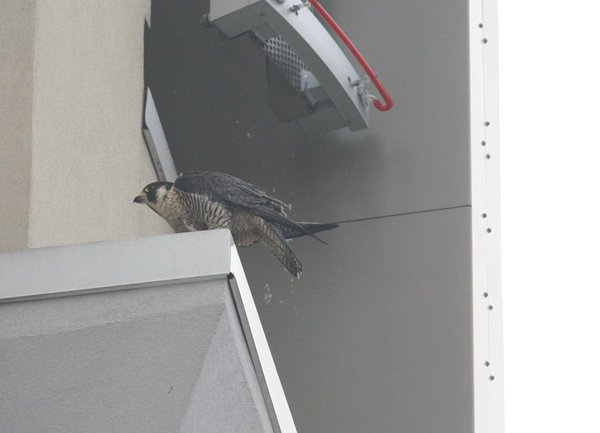
Peregrine Falcon - Catherine Hamilton
Port Chester doesn’t strike one as a birding Mecca, however I pretty much always have my eyes open and my binoculars secreted on me somewhere when I am out and about, as one never knows what you might run into. With a little time to kill on the way to the train station I decided it might be worth having a little scan through the gulls that tend to congregate on the ice/water around the mall in Port Chester. With the ice pretty much all gone, so it seems were the gulls, and it seemed like there wasn’t going to be much to amuse us while we waited for the train. That however all changed with the arrival of the pair of falcons below.
Whilst we were about to scan for the non-existent gulls, Catherine spotted a falcon alight atop the Loews Cinema (the rather small male) followed by a second much larger bird. It was amazing to see the amazing sexual dimorphism in size in the birds with the female obviously much larger (they can be as much as a third the size again as males and weigh more than double). Perhaps this was the reason that the male was just waiting for scraps from the females plate as she snacked on a freshly dispatched Rock Pigeon. This certainly looked like a pair so perhaps the mall in Port Chester or some building nearby might find itself home to a breeding attempt. As with the Pigeons, the Peregrines seem to be right at home in cities where they find the ledges of skyscrapers a perfect simile for their natural clifftop home.
For me it’s always a joy to see Peregrines here in the east. Where once they were extirpated, they are now thriving. A conservation success story in action, which are so very few and far between. It does though give one confidence that where there is a will, that we can actually do something positive for species on the brink of disaster. It’s just a shame with Peregrines that we essentially had to lose the eastern population before anything was done about it.
-

- Peregrine – Catherine Hamilton
-

- Peregrine – Catherine Hamilton

-

- Peregrine – Catherine Hamilton

Comments : Leave a Comment »
Categories : Uncategorized
Sunrise Birding Walk – Saturday Feb 27th
28 02 2010
2CY Glaucous Gull - Mike Ferrari
With an incredible amount of snow engulfing inland Greenwich I was wondering whether this weekends walk was going to go ahead. Whereas most of Coastal Connecticut seemed to escape pretty much scot free I awoke on Friday to find the yard covered in a blanket of heavy wet snow. Pretty nasty stuff all in all and the local roads and power scenario wasn’t looking great either. We managed to get by without a brown out but did manage to lose internet activity somewhere along the way. Thankfully a warm Saturday meant that with a slightly delayed start I was able to escape the confines of Greenwich and meet everyone for a much-needed breath of fresh air.
Stratford is probably one of the more reliable spots in Fairfield County to dig up some nice winter birds. Amongst the business parks and industrial development lies a wealth of great birding spots including marshes, ponds, beaches and coastal grasslands. We started the trip at the end of Long Beach Blvd but apart from a few of the regular waterfowl there wasn’t much happening in the highly flooded marshes. Onwards then to Long Beach where we hit our first nice sightings of the day in the shape of a second cycle Glaucous Gull and a couple of distant Northern Gannets gliding eastwards out over Long Island Sound as well as a confiding gaggle of winter shorebirds in the shape of a good few hundred Sanderlings and Dunlin.
Other stops at Frash Pond, Short Beach and Silver Sands didn’t provide too much else of note apart from a couple of Lesser Scaup a Pied-billed Grebe and a couple of Canvasbacks amongst the more regularly occurring waterfowl species. That said though there were a large number of ducks off of Charles Island including large numbers of Greater Scaup and impressive concentrations of Long-tailed Duck however many of the ducks were just all that bit too far out to go through them what with the heat haze that goes hand in hand with a beautifully sunny and warm winters day. A great day to be out and nice to dig up the Glaucous. Must say I’m looking forward to less snow and some signs of spring soon though.
Trip Species List: Common Loon, Pied-billed Grebe, Horned Grebe, NORTHERN GANNET (Long Beach), Great Cormorant, Mute Swan, Canada Goose, Brant, Mallard, Black Duck, Gadwall, American Wigeon, Canvasback, Lesser Scaup (Frash Pond), Greater Scaup, Common Goldeneye, Hooded Merganser, Red-breasted Merganser, Red-tailed Hawk, Sanderling, Dunlin, Ring-billed Gull, Herring Gull, GLAUCOUS GULL (Long Beach), Great Black-backed Gull, Rock Pigeon, Mourning Dove, Belted Kingfisher, American Crow, Fish Crow, European Straling, American Robin, Song Sparrow, Savannah Sparrow, House Sparrow, American Goldfinch.
Comments : 7 Comments »
Categories : Uncategorized
Long time…
25 01 2010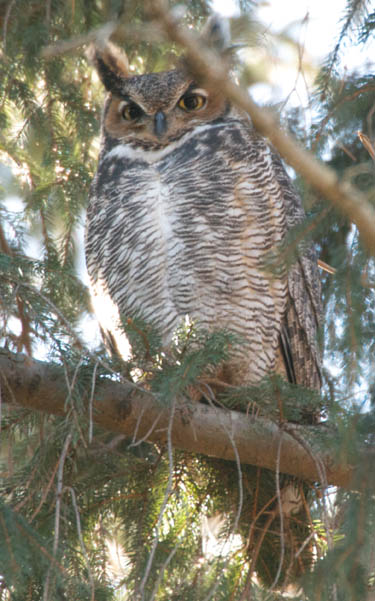
GH Owl- Matt Thomas
Is it just me or is January the most miserable time of year (I am writing this on a day with 30mph winds and steady sheets of rain). It always seems to take me ages to recover from Christmas (a wonderful time spent in London visiting with family and friends old and new, including my friend Peter’s beautiful new baby girl). Anyway there always seems to be a lag in time recovering from being back in the old country and feeling settled back into life here in the states. That’s my excuse for doing nothing with the blog for a while anyway. It also doesn’t help that January is not my favorite time of year for birding. Although I compile the Big January for Connecticut I have to say that having done one once I pretty much vowed never to do it again. I just can’t handle the endless ‘on the go’ pace of the whole thing – more power to those like Tina, Meredith and Sara who throw themselves into the spirit of the thing with gusto – I don’t know how they find the energy!
Anyway this weekend I was back out on the birding trail running a daytime owl prowl. Now as it is owls are hard enough to find even at the best of times but to get to see them during the day it really takes some serious scouting. I basically spent the majority of the week pulling in favors, begging people like AJ who is something of an owl expert and aficionado for tips and traipsing through pine woodlands looking for traces of owl activity. For the most part I was finding a lot of owl sign and not a lot of owls. You also have the misery of owls that you have staked out suddenly deciding to move on just before the day of the walk. Pretty stressful all in all!
It’s all worth it though when you manage to get to the end of a walk with 5 pretty decent owl sightings under your belt. The day started fairly auspiciously when at the first stop a mob of Blue Jays were squawking intimidatingly around the group of pines I was hoping to see our first Barred Owl in. Sure enough these mobbing birds were onto our quarry much quicker than we were and as we watched their frantic behavior a, thus far, hidden Barred Owl dropped out of the trees and flew off for what it hoped would be a quieter pine to roost. Whilst all the time harassed by the baying corvid mob! As I explained to the group, mobbing birds can be your friends and on a number of occasions they have led me towards an owl camouflaged from a mere human’s eye. With a couple more excellent flyby views under our belts as the bird flew this way and that to lose his pursuers (the jays – not us) we left the owl to deal with his tormentors.
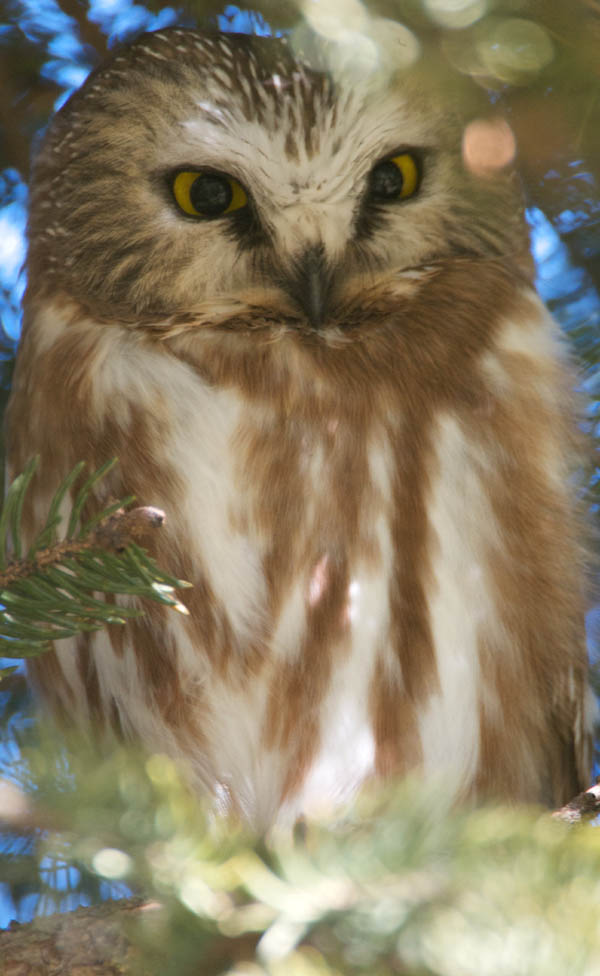
A few more stops yielded some successes and some failures: another Barred Owl perched in some coastal tangles ( but not the Long-eareds that had been hoped for) that provided us with the chance to study the contents of one of the owls pellets and to see the tell-tale whitewash signature that denotes a regular roost. A couple of Great Horned Owls were already getting set up for the serious business of starting a new family for the year, and we had beautiful views of the North-Easts most diminutive owl: the Northern Saw-whet, a bird that one only really encounters in the state in migration and winter.
All in all a pretty successful trip and one that though tough to organize, was all the more rewarding in its success. This year has been a fairly tough one for owls it seems, with very few reports of diurnal owls such as Short-eared and Snowy. Although not reportable in CT, the word on the grapevine is that Long-eared sightings are fewer and farther between than recent years as well. Perhaps the abundance of natural food this year has lead to a corresponding boom in their prey numbers to our north and they just don’t feel the same need to roam south. A good thing for the owls but not so good for your prospective owl hunter!
Thanks to Matt Thomas for the kind loan of a couple of his shots from the trip – thanks for sharing.
Trip Sightings: Barred Owl (2), Great Horned Owl (2), Northern Saw-whet Owl (1).
Others: Canada Goose, Mallard, Ring-necked Duck, Red-tailed Hawk, Red-shouldered Hawk, Herring Gull, Ring-billed Gull, Rock Pigeon, Mourning Dove, Belted Kingfisher, Downy Woodpecker, Blue Jay, American Crow, Black-capped Chickadee, Tufted Titmouse, Red-breasted Nuthatch, Golden-crowned Kinglet, American Robin, European Starling, Eastern Towhee, American Tree Sparrow, Song Sparrow, White-throated Sparrow, Dark-eyed Junco, Northern Cardinal, American Goldfinch, House Sparrow.
-

- GH Owl- Matt Thomas
-

- Saw-whet – Matt Thomas
-

- Saw-whet – Luke Tiller


Comments : 3 Comments »
Tags: barred owl, great horned owl, northern saw-whet owl, Owl, owls, saw-whet owl
Categories : Uncategorized
Sunrise Birding Walk – Dec 5th
8 12 2009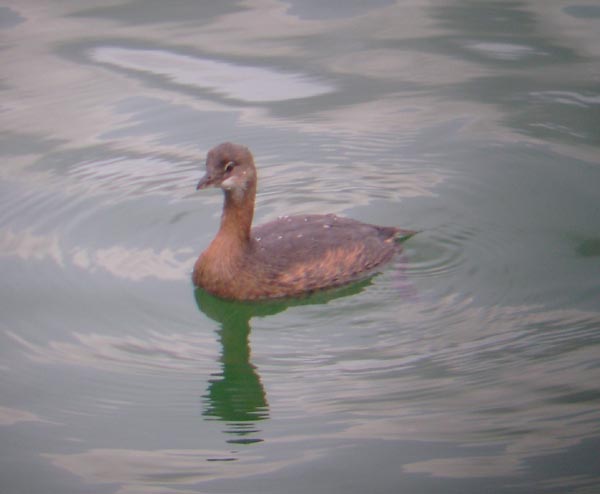
Pied-billed Grebe - Luke Tiller
Saturday I met up with a group of hardy birders for a tour of a few of the local Reservoirs in hopes of finding some interesting waterfowl. Instead of waterfowl we managed to mainly stumble upon a rather strange mix of raptors.
We started our tour at a vantage point over the Hemlock Reservoir where things initially seemed quiet, our first stop point landing us one American Crow and that was about it! However the next stop proved to be a nice and productive one when an adult Bald Eagle took flight across the reservoir as we studied a flock of distant ducks which included a couple of Buffleheads and a flotilla of Hooded Mergansers. The eagle was getting harassed by a group of local crows and therefore put on a bit of a show as it zigzagged across the reservoir looking for a quiet perch. Although I’ve seen huge numbers of Bald Eagles this year at the hawkwatch it never ceases to amaze me how much excitement a Bald Eagle sighting engenders even amongst the hardiest of birders. When you get the chance to share that first Bald Eagle moment with a group of kids or even non-birding adults at the hawkwatch it really is priceless.
Next stop we were on to the Aspetuck Reservoir. This really is probably amongst my favorite waterfowl birding spots as it always seems to provide something of interest. It didn’t disappoint Sunday either. We arrived to find a very late immature Osprey perched up in one of the trees I regularly see eagles in and even better it was in the process of chowing down on a rather large fish giving us plenty of time to observe it and note the pale fringes to the back and wing feathers that gave it the scalloped look of a young bird. Just a few trees along another unexpected raptor. This time in the shape of a rather out of place seeming immature Peregrine Falcon. The falcon was interesting to watch as it seemed to be rather intrigued by the number of waterfowl on the reservoir but rather than actually attacking them it seemed to be making rehearsal sorties out low over the water as if it was testing out its desire to fly low enough to try and snatch a duck off of the water. Whatever it was doing it was cool to watch this awesome bird of prey in simulated attack flight. There wasn’t a great deal of variety on the water however just a few American Black Ducks, Mallards and Ring-necks to add to the already observed species.Next stop was at the far end of the Reservoir. Again the waterfowl mix was somewhat limited but we did manage to add a rattling kingfisher to our tally as well as a few Red-breasted Nuthatches that were calling from the surrounding pines which added to the nice northerly feel to this beautiful spot (it’s the spot the banner photo was taken for my website!)
The third reservoir stop was at the Saugatuck in Redding. The nice thing about these three reservoirs is that they are all in close proximity to each other and also seem to attract different birds. The Hemlock is usually the least productive but both it and the Saugatuck seem to provide deep enough water for serious diving ducks (Common Mergansers) and even the odd sea duck or loon. The Aspetuck on the other hand seems to provide better puddle duck action – although it too can often have a nice mix of aythya’s on it – including Redhead. As we stopped at the Saugatuck we were not overawed by the number of ducks on the water, however we did manage to add a nice little grouping of Ruddy Ducks as well as a couple of rather pretty Pied-billed Grebes.
Final stop of the day was Saugatuck Falls for an explore of the Cedar stands. No sign of owls there this year so far it seems although we did find some white-wash and skunk remains that would lead one to think a Great Horned might be on the prowl in the area. A seemingly rather fruitless stop was enlivened by a little raucous mixed flock of birds that included a Brown Creeper or two just as we were about to leave.
Trips Species List: Pied-Billed Grebe – Mute Swan – Canada Goose – Mallard – American Black Duck – Ring-Necked Duck – Bufflehead – Hooded Merganser – Ruddy Duck – Turkey Vulture – Osprey – Bald Eagle – Red-tailed Hawk – Peregrine Falcon – Herring Gull – Mourning Dove – Belted Kingfisher – Red-Bellied Woodpecker – Northern Flicker – Downy Woodpecker – Blue Jay – American Crow – Tufted Titmouse – Black-capped Chickadee – BROWN CREEPER – White-breasted Nuthatch – RED-BREASTED NUTHATCH – Carolina Wren – Golden-crowned Kinglet – American Robin – Cedar Waxwing – Song Sparrow – White-throated Sparrow – Dark-eyed Junco – Common Grackle – House Finch – American Goldfinch
Comments : 3 Comments »
Categories : Uncategorized
Quaker Ridge Hawkwatch Season Roundup Talk – Dec 9th
1 12 2009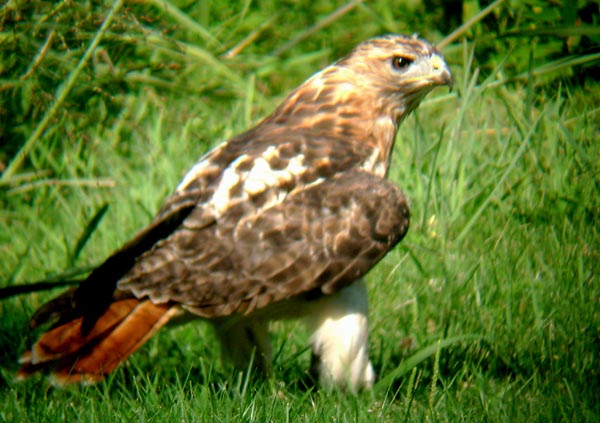
Quaker 'Tail - Luke Tiller
After an amazing season at Quaker Ridge, I’ll be giving a presentation on the highlights of the year at Greenwich Audubon on December 9th at 7.00pm. More in their newsletter (online here). I’ll be talking a bit about the migration process, as well as some of the highlights that were seen over the three months that I was carrying out the count. As well as highlighting some records and interesting sightings I’ll also take a little look at some of the status of some of the key birds that migrate overhead. I hope to see some of you there.
Comments : 1 Comment »
Tags: greenwich audubon, quaker ridge
Categories : Uncategorized
Sunrise Bird Walk – November 29th
30 11 2009
American Robin - Luke Tiller
After the howling winds of Saturday it was nice to get out and do some birding with a number of Sunrise Birding regulars and a new face or two. It was a beautiful day to be out with sun shining and temperatures rapidly climbing into the high 50’s. It appears to have been an odd November and fall thus far with no real sign of a big frost at all. At the hawkwatch we were wondering whether the lack of big movement of some raptors was down to this balmy weather, and lack of big fronts, causing some lack of impetus for the big flight. Although I have been tied up enough to have missed out on a daily sojourn to Allen’s Meadows it seems to have been a fairly quiet fall all around for even relatively common migrants (I still haven’t seen an Orange-crowned this year!!!!) apart from Greg’s notable loon find. Perhaps the influence of some heavy northeasterly winds driving migrants off the coast early in the season?
Everything somehow seems to be either behind, to have slipped past or perhaps not to have arrived yet. With warm temperatures and open water to our north there doesn’t seem to have been the big push of waterfowl as of yet and so things are all seemingly in that rather quiet transition period. It’s also worth noting that their appears to have been an abundant wild food crop this year and so it seems unlikely that any irruptive species will be making the kind of huge forays into our territory that we have seen in recent years such as White-winged Crossbills, Red Crossbills and particularly Pine Siskins. This abundant food crop probably means that the prey species of many raptors is fairly bountiful so there hasn’t been any notable movement of some of these other hoped for species.
Still after a wonderful Thanksgiving with friend and Sunrise Birding leader Joe Bear and his family, it was nice to get out and walk off a few pounds of turkey and Fran’s amazing apple cake! Joe joined us for the walk as well- you can tell it’s warm if he’s out in November – usually he’s hibernating by this time of year and waiting for the warblers to reappear in April 😉 The birding was not the most thrilling of all time but there was much catching up to do with friends who had just returned from the Sunrise Birding tour of Brazil’s Atlantic rain forests, and so good conversation filled in the moments between birds.
A sprinkling of sparrow species at Cove Island turned up a Field and an American Tree Sparrow and a latish Ruby-crowned Kinglet was of some note. Things were pretty quiet though and highlight was a pair of Peregrine Falcons streaking across the sky together as they headed westwards. We got a nice little workshop on Accipiter identification with both Sharp-shinned and Cooper’s Hawks providing decent perched and in-flight views. No sign of the eagle flight that Tina Green had noted the previous day – perhaps they just like it that windy?
We then decided to take a quick run to Greenwich Point Park. Again things were a little quiet but we were starting to amass a decent collection of waterfowl on the day – especially after we had a little flock of 25+ Snow Geese somewhere out midsound – perhaps on their way to Jamaica Bay. Also slightly unexpected on the sound were a little pod of Ruddy Ducks that were huddled together in a tightly massed formation. Long-tailed Ducks seemed to be around in decent numbers and a few mergansers of both the Hooded and Red-breasted varietals put in an appearance. A nice day to be out, even if not mind-blowing birding wise. It was all rounded out with a rather fantastic slap-up meal at the City Limits Diner in Stamford where we retired for essential coffee and more catching up on news and tales of Thanksgiving exploits.
Trip species list:
Red-Throated Loon – Common Loon – Great Cormorant – Double-crested Cormorant – Mute Swan – SNOW GOOSE – Canada Goose – Brant – Mallard – American Black Duck – Long-Tailed Duck – Bufflehead – Red-breasted Merganser – Hooded Merganser – Ruddy Duck – Turkey Vulture – Sharp-Shinned Hawk – Coopers Hawk – PEREGRINE FALCON – Ring-Billed Gull – Herring Gull – Great black-backed Gull – Rock Pigeon – Mourning Dove – Monk Parakeet – Belted Kingfisher – Red-Bellied Woodpecker – Northern Flicker – Downy Woodpecker – Hairy Woodpecker – Blue Jay – American Crow – Tufted Titmouse – Black-capped Chickadee – White-breasted Nuthatch – Carolina Wren – Ruby-crowned Kinglet – Hermit Thrush – American Robin – Northern Mockingbird – European Starling – Cedar Waxwing – American Tree Sparrow – Field Sparrow – Song Sparrow – Swamp Sparrow – White-throated Sparrow – Dark-eyed Junco – Northern Cardinal – House Finch – American Goldfinch – House Sparrow
Comments : Leave a Comment »
Tags: sunrise birding
Categories : Uncategorized
 Under Clear Skies