Hudson River Eagles Trip – Feb 8th

11 02 2009

On Sunday my ‘local’ walk took one of our few forays out of Connecticut for a trip over to the Hudson River looking ostensibly for both eagles and owls. I had done a little scouting on Friday and had been happy to find a host of Eagles but to my horror the roosting site of some of the sought after owls had a gaggle of workmen hammering away at something underneath them. Seeing me peer longingly into the pines one of the workmen chirped up with a ‘not here today’ obviously knowing what I was searching for. I tempered my reply avoiding the ‘you don’t say’ and just said thanks and moved on, praying that they would have returned by the Sunday.

Unfortunately for the sake of the tour the owls had obviously had enough and although we found plenty of pellets, whitewash and other roosting owl detritus from two different species we struck out on owls for the day. It’s hard not to feel a little disappointment as a tour leader when a place that you know can be so wonderful doesn’t quite meet up with your expectations for the day, although I always try to remember what a good friend of mine always says: ‘if you want guaranteed bird sightings you are better off going to the zoo.’

We did however do fairly nicely when it came to Eagles on the day, finding birds at Croton-Harmon Station soaring around the now open water. Thanks to a big thaw and temperatures in the high 40’s on the day things were quite different than Friday although honestly it was a blessed relief after so many frigid tours of late.

I have lead tours on the Connecticut River and still volunteer for the CAS Eagle Festival (sadly canceled this year) and have seen multitudes of Bald Eagles in that time. However it never ceases to give me a thrill seeing these magnificent birds. What is best about seeing all of these birds is knowing that with the help of conservationists and environmentalists we have managed to drag this species back from the brink of destruction after the dark days of DDT poisoning. Best of all is seeing all the young birds that will go on to secure the future generations of this species (I remember talking to old hands who said the most depressing thing in the late 60’s and early 70’s was seeing how few young birds were coming through each year.)

We then moved on to Croton Point Park proper . The park is the site of an old landfill (now grassland) and juts out into the mighty Hudson. The scenery there is beautiful and the birding can be sublime (in previous years I have been there when Short-eared Owls in large numbers have been actively hunting the site by day). Things were a little quieter than I had hoped but we still managed good looks at a number of Harriers which we discussed identifying to age and sex. Highlight was a particularly co-operative Grey Ghost, probably one of the more beautiful and graceful raptors in North America. Unfortunately no sign of a Roughie which can often be found here.

Exploring the park a little further we stumbled upon a large mixed flock of finches, but as hard as we searched we couldn’t find an Redpoll amongst them. Other highlights were 4 or 5 eagles sat on the ice almost playing with a few large fish that had washed up out of the river. I guess they had been feeding pretty well recently as these situations often lead to some scrapping. We talked about aging the eagles (which can usually be safely aged although it is a little more complicated than some texts suggest) and when they reach sexual maturity (4 or 5 years). The other interest sighting of the day was the huge rafts of Common Mergansers sitting out on the Hudson, staging up for their flight north. There were at least a couple of groups of these glorious birds numbering in the hundreds and somewhat surprisingly almost all were males (probably trying to get a head start on the trip north to set up their territories).

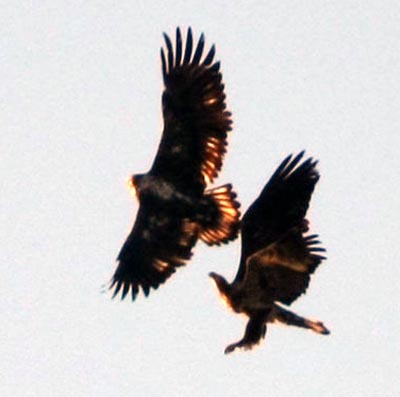
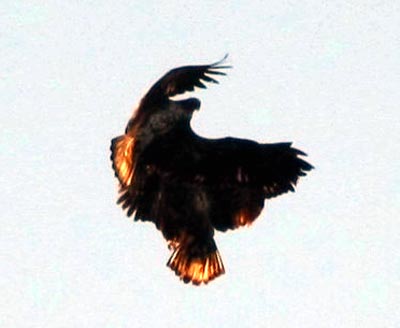
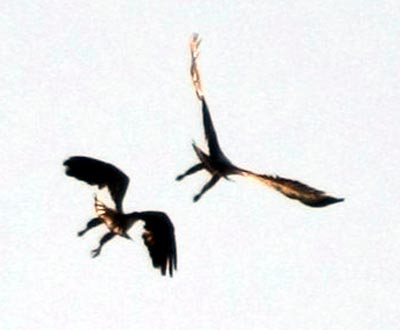
To end the day we stopped over at George’s Island. This is a well known eagle roost and towards sundown one is almost guaranteed good sightings and good numbers of roosting Bald Eagles. We arrived  little early to find one adult bird sitting in one of the trees but we were not waiting long before there were five birds all in the air at one time. As birds flew in and began to settle in for the night two young birds put on quite the show – perhaps practicing their courting maneuvers for future years (see the atmospheric shots from Michael below), or maybe just having a little fun for the day. This sky dance was the perfect end to the day and although there were still Eagles drifting in as we left, everyone was desperate to go grab a warming bowl of soup and a cup of Coffee. We ended the day back at Croton more in hope than expectation that some owls might put on a dusk appearance but although the scene was set perfectly for them with a beautiful wintery full moon they just weren’t playing ball today.

Still a fun day out with lots of great people and it was great to catch up with some old friends and introduce some new ones to the site. The eagles were as fantastic as ever, although the supporting cast could have been better.  Next year it’ll be awesome there I am sure.


Owl Prowl – Additional Photographs

26 01 2009

Here are a couple of great additional pictures from the Owl Prowl taken by Steve Ballentine on the day.  Thanks again for sharing them Steve.


Sunrise Bird Walk – Daytime Owl Prowl Jan 24

25 01 2009

What no owl? - Luke Tiller

What no owl? - Luke Tiller

Another weekend, another wonderful birding trip. This was my first attempt to run an owl prowl for Sunrise and it turned out to be a very successful day (even if I say so myself). Part of the problem with owls is that personally I believe one needs to be almost hyper sensitive of their needs as they can ill afford to be expending extra energy. Raptors have a hard enough time in winter as it is and birds that are roosting during the day should be left as undisturbed as possible. At the same time it is nice to show people these birds as they are highly appreciated and often they are difficult to find even when you know where and how to look (part of the trip was an attempt to help people decide where to look for and what to look for to find their own owls in the future).

In the event we managed to get good looks at 3 species of owl and best of all it was all done by a very respectful and appreciative group.  I specifically picked public places to look, where the appearance of a few birders wouldn’t make any real difference to the birds usual routine. Highlights of the trip were obviously LONG-EARED OWL, GREAT HORNED OWL and BARRED OWL. The Barred  in particular gave us a great demonstration of how hard these birds can be to find even when you know where they are, as it finally revealed itself to us after we had walked underneath it a couple of times (as had numerous dog walkers, dogs, hikers etc).

There is something still kind of mystical and magical about owls and I love to see them although I do it  rarely (doing some scouting I found a few other owls but most were too flighty, in too vulnerable positions, or just simply too far from the route to share with a group). Sometimes I think the impression is on CTbirds is that there is an in clique of birders that share these sort of sightings, but in my experience there really isn’t. I generally do not share any owls I find and at the same time I pretty much expect the same from my birding friends. Even when I get a tip off about an owl I generally don’t follow up on it as I don’t want to disturb the bird, and for me the real thrill is finding ones own owls. That moment you suddenly stumble on one is quite unbelievable.

I remember the first time I found a Saw-whet, I looked under a tree and found some pellets and expected as usual to look up in the tree and find it empty but to my surprise there the a bird sat winking down at me. A fantastic experience that will stay with me forever. It is that experience that you want to share with people, but at the same time you are always drawn in the other direction of leaving the bird alone to just get on with its life without disturbance.

On the trip I also mentioned the dangers of getting too close to owls especially when they are nesting. Highlighting this was British bird photographer Eric Hosking who famously lost an eye whilst trying to photograph a Tawny Owl (a member of the Strix family which includes Barred, Spotted and Great Grey in the US). He basically became famous after that attack and his autobiography was amusingly titled ‘An Eye for a Bird’.

Of course checking pine stands in winter you are always likely to turn up some other goodies. Highlights included a small flock of WHITE-WINGED CROSSBILLS, PINE SISKINS – almost ubiquitous this winter (I checked online and it is estimated there are as many Pine Siskins in the US as there are Goldfinches so it’s no wonder they appear to be so many in these big incursion years), BROWN CREEPER, MERLIN, 31 BOAT-TAILED GRACKLES and GLAUCOUS GULL (obviously not in a Pine Stand!!!).

A nice day out shared with old friends, some new faces and some amazing birds. Saturdays really don’t come much better. Thanks to everyone for coming and to Shaun Martin and AJ Hand particularly with help locating a couple of these hard to find birds.

Trip List

Mute Swan, Canada Goose, Brant, American Black Duck, Mallard, Common Goldeneye, Hooded Merganser, Red-tailed Hawk, Merlin, Turkey, Dunlin, Herring Gull, Great Black-backed Gull, Glaucous Gull, Ring-billed Gull, Rock Pigeon, Mourning Dove, Great Horned Owl, Barred Owl, Long-eared Owl, Downy Woodpecker, Horned Lark, Brown Creeper, Black-capped Chickadee, Tufted Titmouse, Carolina Wren, Golden-crowned Kinglet, American Robin, Blue Jay, American Crow, Northern Cardinal, American Goldfinch, Pine Siskin House Finch, American Tree Sparrow, White-throated Sparrow, Song Sparrow, DE Junco, Boat-tailed Grackle, White-winged Crossbill, European Starling, House Sparrow


Sunrise Bird Walk – Penfield Reef

21 01 2009

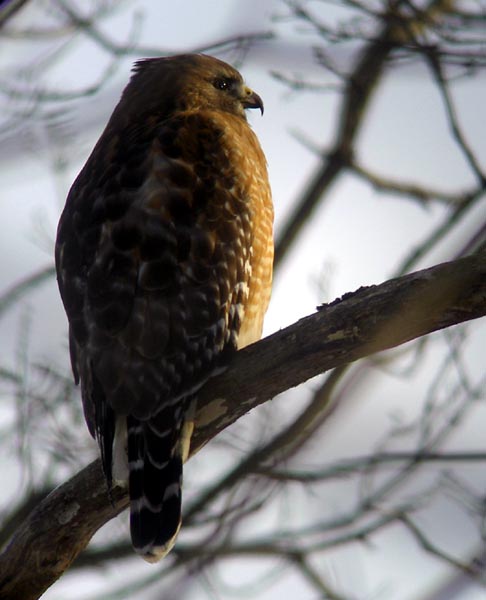
Red-shouldered Hawk - Luke Tiller

Red-shouldered Hawk - Luke Tiller

It was a freezing Saturday morning when I rolled out of bed to see the temperature reading -1 degrees f. I called a few people and the general consensus seemed to be that everyone was staying tucked up in bed for the morning however after calling around a couple more participants it seemed like some hardy souls were braving the weather and heading out for the walk.

Penfield Reef in Fairfield is usually a great spot to look for shorebirds, gulls and ducks in winter but unfortunately for us on the day the ducks had attracted the attention of the local hunting fraternity (mental note for self to do this trip on Sunday next year when the hunters won’t be out!!!!!) With the constant boom of gunfire and the bitter cold temperature we decided to skip the hike on the reef and head for more sheltered climbs.

Another spot that is good for a host of wintering birds nearby is Pine Creek. We stopped in there and were quickly greeted by a pair of raucous Red-shouldered Hawks who seemed to be either wooing or trying to drive each other away. It was cool to hear them vocalizing so vociferously on such a frigid morning. In between the two duelling Red-shouldereds a young Red-tail sat looking pretty doleful – perhaps they were cramping his style? A couple of other nice finds there included 2 FOX SPARROWS.

After losing a member of the group we then headed towards the bottom of Reef Rd where I have had good luck with half-hardy species in the thickets around there. Even I was surprised to find a total of 6 FOX SPARROWS all fighting for space in a tiny little bare patch of grass along with a cracking male EASTERN TOWHEE and a Field Sparrow.

All in all a nice day out. Just to confirm for me that Sunday was the day to go Charlie Barnard emailed me to say he had a decent day out on the reef on Sunday with 100 Ruddy Turnstones, 1 Glaucous Gull and 1 Iceland Gull (next time!) Thanks to everyone who braved the elements on the day!

Trip Species List:

Canada Goose, Brant, American Black Duck, Mallard, Gadwall, Greater Scaup, Long-tailed Duck, Common Goldeneye, Red-breasted Merganser, Hooded Merganser,  Red-tailed hawk, Red-shouldered Hawk, Ring-billed Gull, Herring Gull, Great Black-backed Gull, Mourning Dove, Downy Woodpecker, Monk Parakeet, Black-capped Chickadee, Tufted Titmouse, Carolina Wren, American Robin, Blue Jay, American Crow, Northern Cardinal, American Goldfinch, House Finch, EASTERN TOWHEE, American Tree Sparrow, White-throated Sparrow, Song Sparrow,  Savannah Sparrow, DE Junco, FOX SPARROW, European Starling, House Sparrow


Sunrise Bird Walk – January 10

11 01 2009
gho400

GH Owl - Steve Ballentine

Spent a cold but entertaining morning at a few spots in Westport. Highlight of the walk was the sheer number and variety of waterfowl out on Long Island Sound (no need for the early season worries on CT Birds).  Nothing rare in and of itself and the most uncommon ducks (the WW Scoter) were not very cooperative but plenty of great looks at the common stuff and I was quite surprised to see a couple of ‘flocks’ of Red-throated Loons out on the sound, something I have noted a couple of times in migration but not knowingly in mid-winter before (perhaps the impending storm was pushing birds into the sound?)

The bird of the day was a Great Horned Owl (no locations being given on nocturnal owls I’m afraid – in keeping with CTBirds policy), which although sat quite some way up a tree did provide for a good photo opportunity (thanks for letting me use one Steve). Probably the other real highlight was a stunning first cycle Iceland Gull that was loafing round the point at the 9-11 memorial.

A good friend of mine was asking the other day why 1st cycle had replaced 1st winter etc as a favored terminology with gull identification? The Howell and Dunn book has a useful explanation (see online copy here – explanation on page31) which seems to mainly revolve around creating a neutral system to describe birds that either straddle the two hemispheres or are predominantly southern hemisphere breeding birds. The book is a great place to start with Gull identification, although I must admit to finding some of it a bit long-winded. But then again I guess that’s gulls for you!

A couple of other nice finds on the day were some Pine Siskins (almost ubiquitous this year) at Long Shore and a couple of lingering Snow Buntings which were hanging out with a Horned Lark Flock at Compo.

Trip Species List

Common Loon, Red-throated Loon, Horned Grebe, Mute Swan, Canada Goose, Brant, American Black Duck, Mallard, Gadwall, American Wigeon, Greater Scaup, Long-tailed Duck, White-winged Scoter, Common Goldeneye, Bufflehead, Red-breasted Merganser, Hooded Merganser,  Red-tailed hawk, Ring-billed Gull, Herring Gull, Great Black-backed Gull, ICELAND GULL, GREAT HORNED OWL, Mourning Dove, Downy Woodpecker, Northern Flicker, Horned Lark, Black-capped Chickadee, Tufted Titmouse, Carolina Wren, American Robin, Blue Jay, American Crow, Northern Cardinal, American Goldfinch, PINE SISKIN, House Finch, American Tree Sparrow, White-throated Sparrow, Song Sparrow,  Savannah Sparrow, DE Junco, SNOW BUNTING, European Starling, House Sparrow


Sunrise Bird Walk – Jan 4, Stratford

6 01 2009
Long-beach Sunset

Long-beach Sunset

Although we were scheduled to head to Milford for the morning, with the current crop of great sightings in Stratford I rerouted the tour for the day to hit a few likely spots there. In the end there was plenty to keep us occupied although I had hoped to manage to get to Silver Sands before the end of the walk and didn’t.

It is always a risk going to somewhere that you know there are  good birds around as there is always a chance of missing something and coming away a little disappointed. Well we did miss a few of the hoped for species on the morning but I think the birds we did find were a nice compensation.

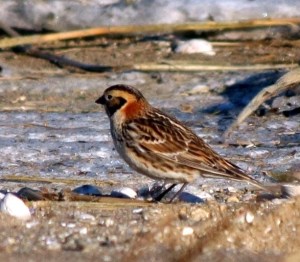
Lapland Longspur - Michael Ferrari

Lapland Longspur - Michael Ferrari

Highlight spectacle wise were the massive flock of Greater Scaup (4-5000?) that were flying up the sound eastwards. I was using their primary pattern to identify them (note in this comparrison illustration the way the white extends through the primaries on Greater Scaup) but as a general rule most scaup on the sound would tend to be Greater and birds on a pond or in a harbor would be Lesser (of course there are exceptions).

Bird wise the three LAPLAND LONGSPURS (or Lapland Buntings as they are known back in the old country) were my favorites. I love Longspurs and Snow Buntings, they just seem so tough the way they stick it out in the most inhospitable spots at the most inhospitable time of the year. Plus I must say I am more of a passerine fan than anything else, so these birds keep me going through the winter when there are few passerines gracing the state. Added to that we had 5 fairly uncooperative AMERICAN PIPITS (although one did provide better views when we went to retrieve cars from Long Beach) a flock of HORNED LARKS and 5 SNOW BUNTINGS to round off the regularly occurring pipits, larks, longspurs and buntings for the season.

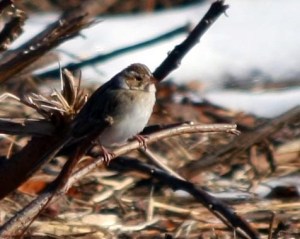
Probably the rarest bird of the trip and a State or life bird for many was the CLAY-COLORED SPARROW. Of course I am avowed sparrowphile, so it was nice to see this bird again (my lousy digiscoped pictures of this same bird in November here). A great looking bird and it performed fairly well, which was useful as it was accompanied by both Fields and Trees for a Spizella trifecta making picking it out from the group somewhat difficult. Added to the nice assortment of sparrows on the day was an Ipswich Savannah Sparrow. A great looking sparrow which made a nice comparison to the common or garden Savannah that we had over at the Gun Club.

Clay-colored Sparrow - Michael Ferrari

Clay-colored Sparrow - Michael Ferrari

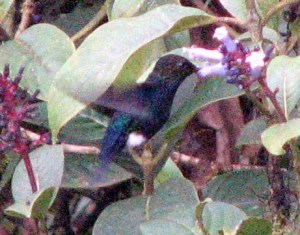
I was also talking on the trip about this great little part of the Birdlife International website (which is worth an explore in and of itself) which has species fact sheets for all of the birds in the world (here). Out of interest I looked up the rarest bird I have ever seen – Black-breasted Puffleg (see awful picture from last July in Ecuador below) and here is the species sheet for that bird. I am currently trying to arrange a trip to Ecuador to go back and see this beautiful and rare bird (details to come soon on my trips and tours section).

Black-breasted Puffleg - Luke Tiller

Black-breasted Puffleg - Luke Tiller

Trip List- 50 Species

Great Blue Heron, Black-crowned Night Heron, Mute Swan, Canada Goose, Brant, American Black Duck, Mallard, Gadwall, American Wigeon, Canvasback, Greater Scaup, Long-tailed Duck, Common Goldeneye, Bufflehead, Red-breasted Merganser, Hooded Merganser,  Red-tailed hawk, Sanderling, Dunlin, Ring-billed Gull, Herring Gull, Great Black-backed Gull, Mourning Dove, Belted Kingfisher, Downy Woodpecker, Horned Lark,  AMERICAN PIPIT, Black-capped Chickadee, Tufted Titmouse, Carolina Wren, American Robin, Northern Mockingbird, Blue Jay, American Crow, Northern Cardinal, American Goldfinch, House Finch, CLAY-COLORED SPARROW, Field Sparrow,  American Tree Sparrow, White-throated Sparrow, Song Sparrow,  ‘Ipswich’ Savannah Sparrow, Savannah Sparrow, DE Junco, LAPLAND LONGSPUR, SNOW BUNTING, Red-winged Blackbird, European Starling, House Sparrow


Save the Albatross

19 12 2008
Waved Albatross - Luke Tiller

Waved Albatross - Luke Tiller

This June I was lucky enough to have traveled to the Galapagos as a leader with Sunrise Birding, whilst there we got to have the most amazing audience with Waved Albatrosses. I remember vividly the absolute awe and excitement they engendered as they greeted us off of Espanola Island (trip report). Participants on this years Sunrise Birding trip to Alaska were lucky enough to encounter 3 different species of these magnificent birds on the trip including the Short-tailed Albatross (picture here) one of the most threatened birds on the planet, which are currently at about 300 breeding pairs (an actual improvement from a point where it was literally on the brink of extinction).

The sad thing is that this wonderful family of birds are amongst the most threatened on the planet. These long lived birds face a number of threats to their continued survival. The main threats have been the introduction, both deliberately in the case of the Galapagos and accidentally in the case of Gough Island amongst others (see recent story on Tristan Albatross here), of non-native mammals that destroy nests and chicks. Habitat destruction is also a common issue but by far the most important current threat to these birds is the terrible losses caused by long-line fishing.

It is estimated that 100,000 Albatrosses are killed each year by long-line fisheries, amongst huge numbers of other seabirds. There is a solution however, and Birdlife International are working with their global partners to get their recommendations followed up on.  The  ‘Save the Albatross’ site has loads of great information on the various species as well as interesting facts and ways to get involved in the campaign. It’s important to make other birders aware of this sad situation and do what you can to make sure that these birds are there to be enjoyed by coming generations (warning, some of the pictures on the site are a little distressing). Perhaps we need an albatross free tuna campaign?


Sunrise Bird Walk – December 13

15 12 2008

Another chilly but beautifully sunny day in the field that didn’t go totally unrewarded. Unfortunately the highlight birds midweek didn’t get relocated (WW Crossbill, Glaucous Gull) but we did manage to track down a decent assortment of birds including another IPSWICH SAVANNAH SPARROW (that’s three of the estimated 3-6000 seen over the last two weeks) and  a feisty MERLIN that zoomed right past us as it took a typical ground hugging attack trajectory towards the Snow Bunting flock that we were about to go look through (can’t hold it against it too much though as it did perch for perfect views a little later).

Other uncommon species on the day were one immature SNOW GOOSE, one probable LESSER CANADA GOOSE, three fairly mobile AMERICAN PIPITS, 1 or 2 fairly uncooperative PINE SISKINS and one equally uncooperative PURPLE FINCH. We also had a nice flyover of Horned Larks which nicely highlighted the difference in their flight calls from the American Pipits.

All in all a nice day in the field and one on which I got to meet a fellow WordPress Blogmeister, Susan.

Trip Species List

Great Blue Heron,  Mute Swan, Snow Goose, Canada Goose (+ probable lesser Canada), American Black Duck, Mallard, Gadwall, American Wigeon, Bufflehead, Ruddy Duck, Red-breasted Merganser, Hooded Merganser, Turkey Vulture,  Red-tailed hawk, Merlin, Ring-billed Gull, Herring Gull, Great Black-backed Gull, Mourning Dove, Monk Parakeet, Belted Kingfisher, Downy Woodpecker, Horned Lark,  American Pipit, Black-capped Chickadee, Tufted Titmouse, Golden-crowned Kinglet, Carolina Wren, American Robin, Northern Mockingbird, Blue Jay, American Crow, Northern Cardinal, American Goldfinch, House Finch, Pine Siskin, Purple Finch, White-throated Sparrow, Song Sparrow,  ‘Ipswich’ Savannah Sparrow, DE Junco, European Starling, House Sparrow.


Sunrise Bird Walk – December 7

8 12 2008

Baby, it's cold outside

Baby, it's cold outside

We set off on a beautiful snow dusted day to Bridgeport and Stratford looking for winter goodies. As I drove down along the Saugatuck River the scene was beautiful, as the snow had dusted every surface that it had touched the night before. A photographers dream and the kind of scene that is reason enough to want to spend ones winters in New England.

Birding on the day was to be slightly problematic as every municipal park seems to close for snow days in Bridgeport and Stratford even when the snow is literally a half inch deep. Anyway, first stop was the little known but often highly productive Captains Cove. Here we managed to pick up our first uncommon birds of the day LESSER SCAUP. Last year we had so many here Roy who runs the listserve was so surprised by the number I reported he wanted to double check with me that I hadn’t posted either the wrong number of wrong species accidentally.

I love these identification challenge species like scaup, as it allows you to earn your keep as a tour  leader and hopefully impart some identification details that are much more vivid to people in the field than they are staring at them in a field guide. With scaup the head shape is all important but I find although not overly illustrated by Sibley the flank coloration is usually a very reliable fieldmark and usually quite easy to see even at distance.

After an abortive stop at Seaside Park (closed) where we did at least spot a large raft of Common Goldeneye (and a chance for another field class on picking out Barrow’s Goldeneye – a shame there wasn’t one in there !) we stopped over at  Long Beach in Stratford. On entering the park we almost ran over an AMERICAN PIPIT as it lurched out in front of the car flashing us it’s white outer tail feathers. We also found on site an IPSWICH’ SAVANNAH SPARROW (Passerculus sandwichensis princeps). This subspecies breeds only on Sable Island in Nova Scotia and is a real rarity with perhaps as few as three to six thousand birds existing on the planet. It is distinctive enough that it was considered a full species until 1973. Other birds of note were 2 Northern Harriers, a huge mixed flock of Sanderlings and Dunlin and 4 stunning PURPLE SANDPIPERS. Purple Sandpipers are one of the few species that are much more exciting in their basic (non-breeding) plumage than they are in their alternate (breeding plumage) with their jaunty orange legs and bases of their bills.

The final couple of stops on the day were less productive than hoped for but we did get a NORTHERN GANNET heading west at Stratford Point. Until recently Gannets were considered rare in Long Island Sound but there numbers have built steadily so that although still considered uncommon they are at least expected during this season.

Next Walk

Trip Species List

Northern Gannet, Great Cormorant, Great Blue Heron, Mute Swan, Canada Goose, American Black Duck, Mallard, Gadwall, American Wigeon, Long-tailed Duck, Lesser Scaup, Common Goldeneye, Bufflehead, Ruddy Duck, Red-breasted Merganser, Hooded Merganser, Turkey Vulture, Northern Harrier, Red-tailed hawk, Wild Turkey, Sanderling, Dunlin, Purple Sandpiper, Ring-billed Gull, Herring Gull, Great Black-backed Gull, Mourning Dove, Rock Pigeon, Monk Parakeet, Belted Kingfisher, Downy Woodpecker, American Pipit, Black-capped Chickadee, Tufted Titmouse, Carolina Wren, American Robin, Northern Mockingbird, Blue Jay, American Crow, Northern Cardinal, American Goldfinch, House Finch, White-throated Sparrow, Song Sparrow, Swamp Sparrow, Savannah Sparrow, ‘Ipswich’ Savannah Sparrow, DE Junco, European Starling, House Sparrow.


Holiday Gifts for Birders

5 12 2008

thelifeofbirds350

Seeing as we are into December I thought it might be fun to throw out a few holiday gift ideas that I have stumbled upon. It’s always hard to find something for a birder that they don’t already have so I thought that these suggestions might be a little change from the usual field guide (which most of us usually have 10 copies of already!) I’ll probably add to this post as we head into December so check back for (or feel free to send me) more ideas. I am not getting commission on any of this – worse luck.

Videos

Generally there isn’t much that I find that I like in the way of videos. The identification ones are just usually so dull and even if the production quality is high the content is usually bland. Here are a couple of videos I’d recommend though. Have a look through Amazon, Barnes and Noble or Borders and I’ll sure you’ll find them online.

The BBC’s ‘Life of Birds’: A must own. Beautifully filmed and great narration by David Attenborough you couldn’t ask for more (clip here).

The BBC’s ‘Wild China’: not just birds but plenty of great bird sequences in amongst this typically wonderful BBC documentary (clip here).

Kes: About the only movie I know of about a boy and his bird. The northern British accent just makes me think of my Grandmother as well. A bit of a weepie this one but with plenty of laughs along the way (you may need an interpreter for the accents though).

The BBC’s Attenborough in Paradise: A great documentary about the amazingly varied birds of paradise of Papua New Guinea. Even better you could buy your significant birding other a ticket on the trip to Papua New Guinea with Sunrise Birding and see these magnificent birds for yourselves (you’ll have to wait to 2010 though as next years trip of a lifetime rightly sold out very quickly). Gina assures me the viewing is a little safer and easier than the one highlighted by David in the video!

The BBC’s ‘Life in the Freezer’: Not just birds but a real must own for penguin enthusiasts everywhere!

Books

Is it just me or most books on birding as dull as dishwater? Here are a few that I think break out of that mold:

Rare Birds of 2009: Published by the charity Birdlife International this highlights  the most endangered birds on the planet. Best of all a fair portion of the cost goes to conservation causes. Purchase online here.

Luke Dempsey – A Supremely Bad Idea: A Brit expat called Luke who finds himself inextricably drawn to birding – sound familiar? Plenty of humor and well written – where can you go wrong?

Mark Cocker – Birders – Tales of a Tribe: A humorous look mainly at the British birding scene. A good opportunity for US birders to get to grips with the great world of British birding slang: stringy, getting gripped off, dipping – all key words for your average birder.

Kenn Kaufman – Kingbird Highway: An oldie but a goodie. The ultimate in big years in America and much more rewarding and inspiring than that trite Big Year book in my ever so humble opinion.

Audio

Get all of your bird songs on your iPod with Bird jam Just don’t play it constantly on your bird trips, it tends to confuse your erstwhile leader when he hears Elegant Trogon down at Allen’s Meadows.

Flight Calls of North American Birds: Ever wonder how good birders seem to pick up on great birds flying over – well here is part of the trick. Almost essential in my opinion for birding during winter finch irruptions and to pick out cool birds during fall migration.

Kids

Want to inspire potential birders in your family? Here are a couple of cool things I picked up on.

Penguin Boots. How cool are these! I just wished that they made them in a mans size ten 

Proper binoculars for kids. These Leupolds were specifically made with the designers kids in mind and are perfect for young children 5+. You’ll find that they are of good enough quality glass that you’ll want to borrow them back! A quick note – remember when buying binoculars for children the biggest problem they have with most binoculars are not designed with a small enough IPD to fit their smaller faces.

Accessories

A couple of years back I found these great reusable hand warmers in Japan and they now seem to have crossed the pond EZ Heat Hand Warmers – see them in action here. Being reusable I would think they must be a little more eco-friendly than those disposable ones.

My binoculars are always filthy these days but that because i’ve lost my Lens Pen.

Here are a couple of little stocking-filler nik-naks that my wife sent me a link for: Purse, key ring, owl t-shirt

Bumper Stickers that I love from Woodcreeper.com

Non-profit Membership

A great idea for aspiring birders or those that have already been bitten by the bug is signing them up for membership of one of the birding clubs or environmental organizations. Most of them have plenty of great benefits including cool magazines etc and you get to know that your gift is giving in more than one way as the conservation work these bodies do is often invaluable.

American Birding Association. A great organization for birders as their magazine and newsletters are as good as it gets for bird identification articles etc. They also have a youth chapter which many organizations lack.

Connecticut Ornithological Association. Great local birding information. Worth joining for the Connecticut Warbler Magazine alone which includes Greg Hanisek’s quarterly round up of the season in Connecticut as well as great articles by local birders such as Nick Bonomo, Frank Gallo, Mark Szantyr and Julian Hough amongst others.

Audubon Societies. Both National and State Based. These are two separate non-affiliated bodies but they do often work closely together for conservation in our state.

For something slightly more exotic for well traveled friends why not look at the Oriental or Neotropical Bird Clubs?