Another ‘freak folk’ tune this time in the guise of British singer/songwriter Birdengine.
Bird Music: Birdengine – Buried in the black snow
27 05 2011Comments : Leave a Comment »
Categories : Uncategorized
Bird Music: The Appleseed Cast – Peregrine
23 05 2011Thanks to Braddock Bay Raptor Research head honcho Daena Ford for sending me this awesome new track for my collection of bird related music. How appropriate considering the source that it is hawk related too. I guess Lesser Prairie Chickens aren’t the only good thing to come out of Kansas 😉
Comments : 1 Comment »
Tags: bird music, the appleseed cast
Categories : Uncategorized
I am a hawkwatcher!
20 05 2011
I am a hawkwatcher
So over in the world of Facebook I have been hosting some reflections on life as a hawkwatcher in cartoon format. On the aptly named ‘I am a hawkwatcher’ page. If you want to go see the forthcoming installments of the strip, you’ll have to go hit the ‘like’ button on the fan page. Link to Facebook here. Who knows where these ideas and illustrations come from, I just get them delivered to my email inbox every couple of days!
Comments : Leave a Comment »
Categories : Uncategorized
BBBO Female Brewster’s Warbler
20 05 2011
Brewster's Warbler - Ryan Kayhart
Thanks to Ryan for sending me this snap of a 2nd year female Brewster’s Warbler that was banded at Braddock Bay Bird Observatory on Thursday.
Brewster’s is the more common, dominant hybrid between Golden-winged and Blue-winged Warbler with the recessive hybrid being the Lawrence’s. This bird strikes me as somewhat interesting as it seems to retain the single golden wing patch, rather than the double wing bar that one usually associates with illustrations of Brewster’s hybrids: Sibley, Beadle etc. It also has a very feint wash of yellow on the breast (often illustrated as being more extensive in female Brewster’s). A quick Google image search for Brewster’s Warbler shows you just how variable these hybrids can be though (here). Giff Beaton has a nice online collection of eastern wood warbler shots if you want to look at what the individual species look like (here).
Worth noting now also that only the ‘winged’ warblers and the presumed extinct Bachman’s Warbler remain in the Vermivora genus. The rest (Tennessee, Orange-crowned, Nashville, Virginia’s, Colima, Lucy’s and Flame-throated) have been moved out into a new genus Oreothlypis (pronunciations on a postcard please!!!) along with the Crescent-chested Warbler, which until recently was considered a parula.
Comments : 1 Comment »
Categories : Uncategorized
Cerulean Warbler BBBO
17 05 2011
Cerulean Warbler - Ryan Kayhart
I thought people might be interested to see the Cerulean Warbler that was picked up at Braddock Bay Bird Observatory today. I have had a little look for it in the local area but not seen it since. It seems like Cerulean Warblers are almost impossible to find in migration so it’s a particularly nice find for the gang. I’ll post to Genessee Birds if it shows up anywhere. Nothing really in the way of hawks at the watch today but decent warbler numbers could be eked out – highlights being two Blackburians and one Cape May.
Thanks again to Ryan Kayhart for the shot!
Comments : Leave a Comment »
Categories : Uncategorized
Braddock Bay – Not just hawks!!!!
15 05 2011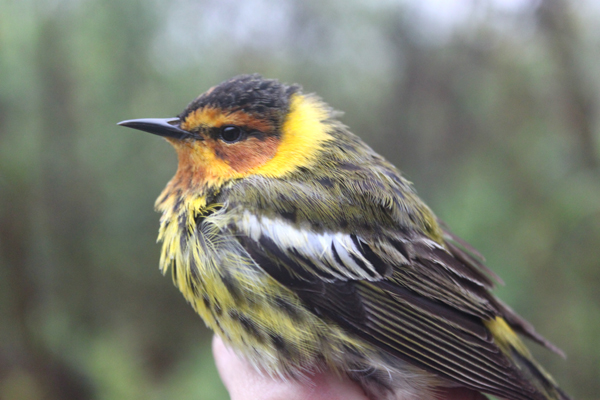
Cape May Warbler - Ryan Kayhart
So if you have been keeping up with my blog you’ll know that it isn’t just the raptors that make Braddock Bay and the local area such a great place to be for spring migration. There is plenty of other goodies to enjoy here as well. So far personal highlights on the season have included Red-headed Woodpecker, American White Pelican, Barrow’s Goldeneye, Eurasian Wigeon, Lewis’s Woodpecker, Sandhill Crane and Swainson’s Hawk amongst the usual owls, ducks, gulls and neotropical migrants.
Thursday at the park was pretty astounding in terms of warbler migration. I thought I’d share my post to Genessee Birds from the day:
” I just wanted to echo that there was some incredible ‘warblering’ to be had at the hawkwatch today. I ran into Brad Carlson who had been checking out the action away from the hawkwatch and once he mentioned Bay-breasted Warbler I had to take half an hour off of hawkwatching for the day and look for some warblers. Post watch I also went back into the woods at the park and much of the same or more of the same birds continued. Most of the birds were on the edge of the woods between the pavilion and the pines at the far end of the park heading towards the lake.
Personally I had the following in rough numbers: Yellow Warbler (40+), Chestnut-sided Warbler (2), Magnolia Warbler (3), Cape May Warbler (6 males & 2 females) including incredible extended views of birds picking through the cherry blossoms low behind the pavilion, Blackburnian Warbler (10+), Black-throated Blue (3), Black-throated Green (10+), Yellow-rumped Warbler (75+), Palm Warbler (10+ all western), Pine Warbler (1), Blackpoll Warbler (3), Bay-breasted Warbler (2) including stunning extended close head height views of one bird, Tennessee (1 ho), Nashville Warbler (10+), Northern Parula (3), Black & White (2), American Redstart (3), Common Yellowthroat (2), Wilson’s Warbler (3) including great views of a very vocal bird.
Other highlights on the day were more Blackburnians and Red-breasted Nuthatch at Owl Woods on the way home and Orchard Oriole and a probable (it didn’t vocalize) Acadian Flycatcher near the Braddock Bay Bird Observatory banding station (broad long bill, distinct eyering, comparatively bright green back, long primary projection). At the hawkwatch a steady stream of Sharpie were jumping off of West Spit and were joined by 2 adult Peregrines and 1 Merlin.”
The next day was almost as impressive with the second bird that I looked at after getting out of the car turning out to be a stunning Prothonotary Warbler!!!!!
Yesterday the rains came, and as well as washing out the hawkwatch it made for somewhat difficult land birding. Still rain or no rain I did decide to have a damp stroll through the local hotspot Island Cottage Woods. Not a great deal of action but a beautiful spot and even on a somewhat slow day I managed to find a couple of Bay-breasts and a couple of jaunty little Wilson’s Warblers (is there a more frenetic warbler?)
Having birded many of the Northeasts migrant hotspots I’d have to say that a good day around Braddock is hard to beat. I think the tally of Cape Mays is probably more than I have ever managed to see in one day anywhere in the US. This amazing mix of birds is what makes Braddock such a focal point for local birders and one that should draw crowds from far and wide.
Interestingly a couple of Queens birders stopped in on their way back from Magee Marsh and were raving about it as an experience. I mentioned the Prothonotary and they didn’t bat an eyelid, but once I mentioned that Greg Lawrence (one of New York’s up and coming young birders) had managed to pick up Connecticut, Mourning, Orange-crowned and Golden-winged just a stones throw from the park I could tell their interest had been piqued (it turned out they had missed three of these at Magee). Once I told them about the 39k Broad-winged Day they were even more intrigued! Anyway after spending a little time showing them some of the lingering warblers at the park and after steering them towards Island Cottage Woods they vowed to be back next year and add it to their migration road trip itinerary.
What could be a more perfect way to spend spring migration? Pop in for a big Broadie flight in Hilton NY and then swing up to Ohio for a week of incredible warblering? Not that you couldn’t have fun looking for warblers here, but then I wouldn’t get to find any of the good stuff if Braddock turned into Magee Marsh 😉
The area banders have been doing pretty nicely as well. Thanks to Ryan Kayhart at BBBO (website here) for the shot of the Cape May from today.
Comments : 2 Comments »
Categories : Uncategorized
Frontiers of Hawk Identification – Hawks at a distance
11 05 2011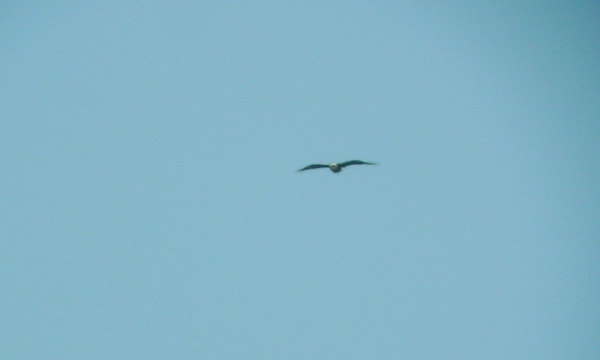
Mystery Raptor #1
I have been looking at Jerry Liguori’s brilliant new book ‘Hawks at a distance’ recently (check it out here). Along with his previous work ‘Hawks at every angle’ (here), and it’s a must own for anyone who has even a passing interest in hawkwatching in my humble opinion. Jerry is pretty much the word in cutting edge identification of hawks in flight these days, in the same way that ‘Hawks in flight’ (Dunne, Sibley, Sutton) revolutionized the way we looked at flying raptors in the 1990’s, so this pair of books has highlighted the developed and expanded upon techniques that hawkwatchers use to identify these birds.
It was cool to hang out with Josh Lawrey this season at Braddock Bay and talk to him about working with Jerry in person up at the Goshutes. Josh was telling me how Jerry pretty much completely rejected the need to use a scope to identify even the most distant hawk and encouraged Josh to stick with bins exclusively to identify birds (pretty much in keeping with the world view of his book). I’m sure this wasn’t solely machismo (which can be pretty rampant in the world of hawkwatching) but rather the practical need to stay off the scope as it so badly limits your field of view. Use of a scope narrows the area of sky you are viewing and correspondingly the number of birds you can observe at at any one time. This eschewing of the use of scopes apparently manifested itself in Jerry making monkey noises at Josh every time he reached for his scope up in the Goshutes, which I thought was particularly funny.

Mystery Raptor #2
Personally I know my limits, and am happy to ‘go to the scope’ every now and then with birds that need a little more work than my comparatively limited skills can manage. Being at Braddock Bay is quite intimidating when one considers the quality of people who have been involved in the world of hawk banding and watching here over the seasons. This began with the hiring of the insanely talented Frank Nicoletti and ran through such luminaries as Jerry himself, Clay Taylor, Jeff Bouton and local legends such as Brett Ewald and Dave Tetlow amongst others. These are guys who have probably forgotten as much about identifying, aging and sexing raptors as I now know.
As well as being intimidating, it’s also inspiring to be part of that tradition. Anyway where was I? Jerry’s new book. I have a copy for myself and also purchased copies for a friend or two, I was so impressed with it. It’s always interesting to get another hawkwatchers perspective on birds, as everyone looks at things in a slightly different way I think and spots characteristics that may help you with an ID. Jerry really is out there at the forefront of hawk identification and the book is an incredibly valuable resource with little gems of information scattered amongst the cracking ‘little’ pictures of the birds.
However, I think I have a minor criticism and perhaps a next project for Jerry 😉 His books all contain perfectly beautiful, sharp little images of the birds, as if they were flying over at a thousand feet or more in crisp blue skies. What happens though on days like yesterday when you have a stinking, shimmering heat haze blowing off of the nearby lake? When under a mile or so away birds are sucked into the swampy air and rendered little more than twinkling shapes as they flicker in and out of the murky air. So now I bring you images from my latest project Luke Tillers very own digiscoped ‘Hawks at a distance in heat haze’, the next step in hawk identification 😉

Mystery Raptor #3
Seriously though, If you don’t own Jerry’s books and having more than a passing interest in raptors – get copies now! If you want to have a little bit of fun, see if you can work out what the above three raptors are. No prizes – just the usual hawkwatchers smug sense of self satisfaction if you call them first and get them right. I’ll post the correct answers on my facebook page and blog in a few days.
Comments : 1 Comment »
Tags: hawk watch, hawk watching, hawks, hawkwatch, hawkwatching
Categories : Uncategorized
Gentlemen Prefer Blondes…
7 05 2011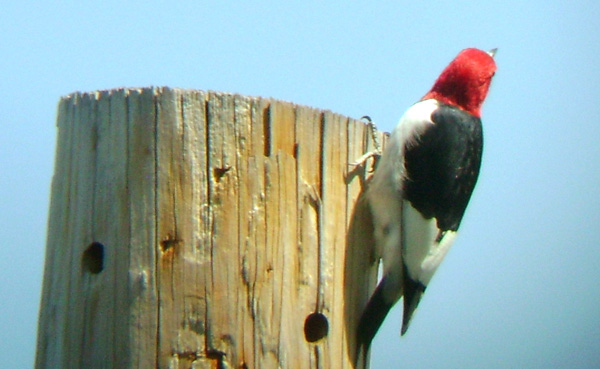
Red-headed Woodpecker - Luke Tiller
But I prefer Red-heads. Well Red-headed Woodpeckers anyway! There can hardly be a bird that combines just three colors that has such an amazing wow factor in North America as the Red-headed Woodpecker. Although essentially a southern species these birds seem to wander north into the upper reaches of New York State in small numbers. Interestingly the first ‘good’ bird I ever found in the states was a Red-headed Woodpecker over at Stratford Point in Connecicut a few Junes ago; probably a post breeding wanderer (Stratford Point is now obviously more famously as the site of the long staying White-tailed Kite). I can distinctly recall the excitement of finding this bird with long-time friend and birding buddy Penny Solum and even better it stayed around long enough for a few of the states more notable birders to go see it, which was nice.
Anyway this was another nice addition to the Bigby list and one that I both was pleased to get a decent (for digiscoping) picture of and hope will actually hang on to breed.You can find out more about the species on the Cornell All About Birds Website (here). Bigby list so far = 151 with these new additions: Green Heron, Whip-poor-will, Red-Headed Woodpecker, Least Flycatcher, Eastern Kingbird, Warbling Vireo, Horned Lark, Wood Thrush, Black-Throated Green Warbler, Common Yellowthroat, Rose-Breasted Grosbeak
Comments : Leave a Comment »
Categories : BGBY
Anatomy of a Broad-winged Hawk Big Day – Braddock Bay – April 27th 2011
5 05 2011
Broad-winged Kettle - Steve Beal
The day had begun almost calmly with just the constant tick, tick, tick of the counter as a regular stream of Sharp-shinned Hawks and the odd Kestrel jumped off of the West Spit and disappeared literally and figuratively into the haze of the lake beyond. This stream is nothing to panic the remotely seasoned watcher by any means, and the flow is light enough to allow a little time to scrutinize and even appreciate the passing flocks of blackbirds. Here and there, groups of Rustys stream by with their Red-winged brethren, belying the rather depressingly diminishing numbers across the continent.
As the gloom and haze lift from the sky, letting in shafts of light and the ensuing heat, the sky becomes at first patchy and then breaks open into a rather beautiful spring day. To the delight of those watching below though the dreaded “Broad-winged Blue” or “Blue sky of death”, that renders hawks almost invisible in its cerulean cloak, never quite materializes. Rather, thankfully, a thin gauze of cirrus stretches across the sky and here and there globules of passing cumulus act as a backdrop to highlight the rivulet of passing birds.
With the rising heat, a corresponding rising of the birds begins to occur, and before long the small and scattered kettles of Broadies become a high and steady torrent of pepper spot birds that surge meaningfully across the sky, driven on by a craven desire to get north to breed. A scan of the sky reveals two thousand in a constant surge here, and three thousand more over there. If you are lucky they stop intermittently to kettle for a while and perhaps drift back over the platform to put on a show for those merely observing below. This drift might also help you catch the tail end of a missed source, but equally may just help to confuse the issue.
“Have you seen these ones?”
“I have them already”
“Are you sure?”
The clipped response a mixture of inquisitiveness and disbelief.
With soaring birds and numbers, the panic is setting in. A counter is quickly proffered to another helping hand (the Sharpies over the bay) and a pen and pad farmed out to another in order to scribe the incidentals: a Red-tailed here, a surge of harriers there and then a stream of Broad-wings that contains eight Bald Eagles, a conservation success story writ large across the cobalt blue April sky. A stream that contains perhaps more eagles than the first counter at this site might dared have dreamed of seeing in a season let alone in this one singular hour. Proof positive that in conservation that sometimes, just sometimes, (yet depressingly all too scarcely) where there is a will there is a way.

Bald Eagle - Steve Beal
The hawkwatcher with his puny vision can only hope to replicate the acuity of the visually enhanced hunters in the sky through the aid of trusted Swarovski, Zeiss or Nikon. Amazing to consider that these birds view of you and your little platform is almost exactly the same as yours is of them, and yet you have clasped to your face a thousand dollars or two of finely crafted and engineered visual aids. Do they see you, and watch you back you wonder? And if so do they care? A hawkwatchers joke that maybe equally they are ticking off hawkwatches on their journey north across the continent! You however are becoming rapidly smaller as they ascend to what must be maximum soaring height.
Behind you comes a call:
“I have 50 more here”
“No numbers please” you urge as you try to keep grasp of the numerals that are now spinning rapidly through your head and off onto the counter affixed to your hand.
Clicking off the Broad-wings in at least 10’s by now. Amusing to reflect on that first singular Broad-winged that rose above the horizon six or seven hours ago, giving prolonged scope views as she lazed listlessly up into the ether above, you little realizing then that she had brought nearly 40,000 of her friends with her.
Before the buteo show had begun, accipiters seared across the bruised sky of the bay. These harbingers of winged death, all glinting eyes and flashing talons that promise a swift death to the swirling mass of thousands of passing passerines: mere “hawk food” to the more dismissive raptor jocks. Many of these accipiters cruise past, crops bulging, the thousands of miles traveled by those five inch long, warbler shaped, miracles of migration ended in a panicked chase across the scattered trees of the West Spit of Braddock Bay.

Sharp-shinned Hawk - Josh Lawrey
Just to keep you on your toes and apropos of nothing, the Broad-wings suddenly splinter across the sky, drifting in across the streets of Hilton Village, an invisible and imperceptible lake breeze effect kicking in. But there is no lake breeze today, so what is causing this frustrating and confusing break up of your line? Something that the birds have perhaps picked up that is impossible for a mere human, or even a mere humans little portable Kestrel weather station, to identify. Then the cause of the birds break up looms across the horizon, a closing line of cloud threatening rain and quite possibly something more destructive – a tornado?
The stream of birds peters out and then dies. The numbers written down just raw figures for now, but already contained on the scrawled data sheets the secret that a record has been broken for Braddock Bay, New York State and perhaps beyond. No time for celebration now though, just the ache of joints inflamed by hours spent on ones feet, the dull throb of reddening skin that carelessly slathered sunscreen had failed to cover and the carpal tunnel pulse of the counters that have been glued to hand for the last ten hours!
As you turn to leave, the sky now foreboding and dark closes in behind you sealing the flight firmly closed for the day. It will be opening again early tomorrow to let those stragglers through. But for now beers and beds are calling!
Thanks to Steve Beal for the kettle and Bald Eagle Shots, you can check out more of his pictures on his photography blog (click here). Thanks also to Josh ‘Livin’ the dream’ Lawry for the accipiter shot. If you want to check out the day in simple numbers you can visit hawkcount.org (here). The day surpassed the previous biggest day in Braddock Bay history (27th April 1987) and probably accounts for the biggest flight day recorded in both NY State for both raptors generally (42,235) and Broad-winged Hawks (39,417) in particular. Doing a little rudimentary research it seems like this could be one of the biggest spring flight days recorded in Canada or the USA?
Comments : 6 Comments »
Tags: hawk watch, hawk watching, hawks, hawkwatch, hawkwatching
Categories : Uncategorized
 Under Clear Skies