Sunrise Bird Walk – Penfield Reef

21 01 2009

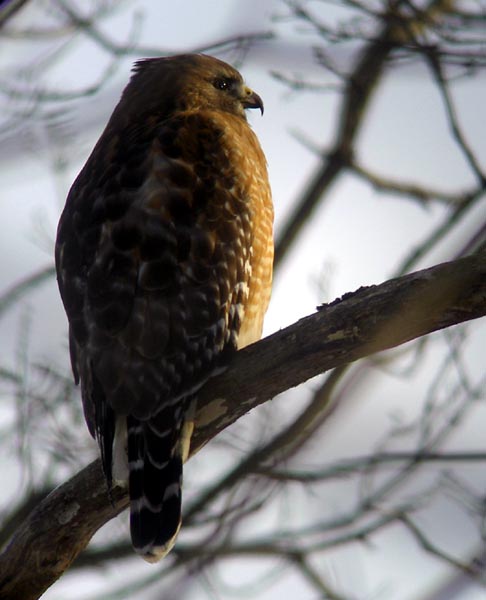
Red-shouldered Hawk - Luke Tiller

Red-shouldered Hawk - Luke Tiller

It was a freezing Saturday morning when I rolled out of bed to see the temperature reading -1 degrees f. I called a few people and the general consensus seemed to be that everyone was staying tucked up in bed for the morning however after calling around a couple more participants it seemed like some hardy souls were braving the weather and heading out for the walk.

Penfield Reef in Fairfield is usually a great spot to look for shorebirds, gulls and ducks in winter but unfortunately for us on the day the ducks had attracted the attention of the local hunting fraternity (mental note for self to do this trip on Sunday next year when the hunters won’t be out!!!!!) With the constant boom of gunfire and the bitter cold temperature we decided to skip the hike on the reef and head for more sheltered climbs.

Another spot that is good for a host of wintering birds nearby is Pine Creek. We stopped in there and were quickly greeted by a pair of raucous Red-shouldered Hawks who seemed to be either wooing or trying to drive each other away. It was cool to hear them vocalizing so vociferously on such a frigid morning. In between the two duelling Red-shouldereds a young Red-tail sat looking pretty doleful – perhaps they were cramping his style? A couple of other nice finds there included 2 FOX SPARROWS.

After losing a member of the group we then headed towards the bottom of Reef Rd where I have had good luck with half-hardy species in the thickets around there. Even I was surprised to find a total of 6 FOX SPARROWS all fighting for space in a tiny little bare patch of grass along with a cracking male EASTERN TOWHEE and a Field Sparrow.

All in all a nice day out. Just to confirm for me that Sunday was the day to go Charlie Barnard emailed me to say he had a decent day out on the reef on Sunday with 100 Ruddy Turnstones, 1 Glaucous Gull and 1 Iceland Gull (next time!) Thanks to everyone who braved the elements on the day!

Trip Species List:

Canada Goose, Brant, American Black Duck, Mallard, Gadwall, Greater Scaup, Long-tailed Duck, Common Goldeneye, Red-breasted Merganser, Hooded Merganser,  Red-tailed hawk, Red-shouldered Hawk, Ring-billed Gull, Herring Gull, Great Black-backed Gull, Mourning Dove, Downy Woodpecker, Monk Parakeet, Black-capped Chickadee, Tufted Titmouse, Carolina Wren, American Robin, Blue Jay, American Crow, Northern Cardinal, American Goldfinch, House Finch, EASTERN TOWHEE, American Tree Sparrow, White-throated Sparrow, Song Sparrow,  Savannah Sparrow, DE Junco, FOX SPARROW, European Starling, House Sparrow


Bigby Surprise – Common Redpolls

21 01 2009
leucard600

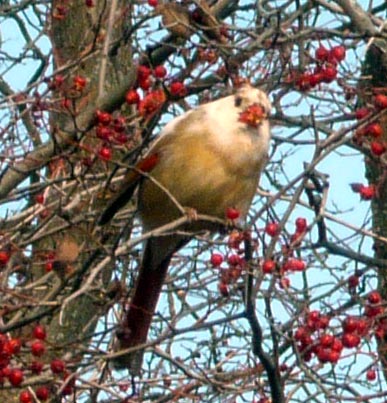
Northern Cardinal - Jamie Van Acker

I was thrilled to add a most unexpected yard and BGBY bird to my list for the year in the shape of a flock of Common Redpolls. I had popped outside to digiscope a Red-shouldered hawk that was loafing around the yard and managed to spot a flock of finches fly in. To my surprise they turned out to be a little flock of Common Redpolls. Bigby year bird 38 and yard list bird 106.

There haven’t been many Redpoll reports this year thus far in Connecticut but I was mentioning to people last weekend that they are creeping ever closer to us, still I was surprised to find the flock here. So far the birches in the yard have made up for the lack of filled Nyjer feeder but today I popped out to get some seed to fill her up. Of course the little buggers didn’t linger long enough to get there photo taken, ditto the camera shy Sapsucker that flew across the yard.

As I don’t have a picture of the Redpolls, I thought I’d post this picture taken by my friend Jamie Van Acker. I think this partially leucistic Cardinal looks kind of cool.

BGBY List – 38 Species (highlights in bold):

Great Blue Heron, Turkey Vulture, Black Vulture, Coopers Hawk, Red-Shouldered Hawk, Red-tailed Hawk, Herring Gull, Rock Pigeon, Mourning Dove, Barred Owl, Belted Kingfisher, Red-Bellied Woodpecker, Northern Flicker, Yellow-Bellied Sapsucker, Downy Woodpecker, Hairy Woodpecker, Blue Jay, American Crow, Tufted Titmouse, Black-capped Chickadee, White-breasted Nuthatch, Winter Wren, Carolina Wren, Eastern Bluebird, Hermit Thrush, American Robin, Northern Mockingbird, European Starling, Song Sparrow, White-throated Sparrow, American Tree Sparrow, Dark-eyed Junco, Northern Cardinal, House Finch, Pine Siskin, American Goldfinch, COMMON REDPOLL, House Sparrow.


New Book Project – Birds and People

16 01 2009

Birds and People - David Tipling

Birds and People - David Tipling

If you have read my post on Holiday Gifts for Birders or perhaps just spent some time with me in the field you’ll know that one of my favorite books on birds and birding is Mark Cockers Birders: Tales of the tribe. He’s, in my opinion, one of the few birders that manages to combine in his work a great sense of humor, a great deal of knowledge and a reverence for the subject all at the same time.

I noted that he has a new book coming out, which was being heavily promoted in the Independent UK Newspaper, the other week (yes in the UK national newspapers are interested in birds, birding etc etc !!!!) The book, Birds and People: A Global Celebration of Birds in Human Culture will be a collection of reflections on our relationships with birds around the globe and they are looking for your contributions! Essentially they are looking for 300 or so word pieces that illuminate our wider relationship with birds, which sounds like an interesting opportunity for all those budding writers out there!

You can read more on this interesting project here. Some of the stories that are going to be included in the book arealready available on the website, as are some of David Tipling’s amazing photographs that will accompany the project – see above (his website can be viewed here). I am really looking forward to publication of this project, it looks fascinating! My favorite section so far is on the Kazakh Eagle Hunters.


When birding goes bad – rarity hoax UK

16 01 2009

It all seemed quite innocent enough, an ex-birder had been out for a round of golf in Wales on a beautiful coastal course and had spotted a lone sea duck in the water. It struck him as something that he hadn’t seen before and so the next day he returned to snap a picture of the bird in question in order to send on to a couple of birders to get their thoughts on the ID of the bird. The fuzzy snap was quickly identified as a rather distinctive female Steller’sEider, a fairly exciting find and perhaps only the 15th or so record for the UK. As is usual the word was rushed out to birders via pagers and mobile phones (the RBA in the UK is a little more advanced than it is here) and birders got in their cars and headed to the site to search unsuccessfully for the bird.

Not so uncommon that a rare vagrant bird flew the coop and so the story might have ended there. However, a couple of suspicious birders thought that some of the description of the find just didn’t ring true and started to do a little digging. Lo and behold the EXIF data from the  camera (which can be found on digital images) did not tally as far as the lens, date of when the photo was supposed to have been taken etc. With a little detective work it was discovered that the picture had been taken in Finland a couple of years earlier and had just been flipped and cropped a little. Quite an amazing and shocking little story. It certainly isn’t the first birding hoax to be perpetrated and I’m sure it won’t be the last, I just hope it won’t catch on on this side of the pond. You can see the hoax picture and the original on the BirdGuides website. ps If you plan to hoax a few good birds it’s probably worth remembering to delete the EXIF data from your stolen pictures 😉


Shade Grown Coffee – it’s for the birds

15 01 2009

ABA - Shade Grown Coffee

ABA - Shade Grown Coffee

If you are, like me, someone who needs a couple of cups of joe before you set off for some dawn birding then perhaps it’s time to think where your coffee comes from.  There was a great article in Birdwatchers Digest this month by Ken Kaufman about the impact the type of coffee we purchase has on birds and specifically the benefit to birds of supporting shade grown coffee growers.

Shade grown coffee is better for wildlife as the plantations are much less disruptive to the native flora and fauna (growing as it does in the understory of a forest, whereas sun coffee requires complete deforestation) and it is also less likely to be as intensively farmed (with pesticides, herbicides, fertilizers etc etc that sun grown coffee  requires to be viable). Other benefits are that purchasing shade-grown coffee tends to support smaller coffee growers and be much better tasting as the beans grow slower, which apparently enhances their taste. You can buy shade grown coffee from the ABA here and there is more information from the Smithsonian here.

Perhaps we need to encourage the Dunkin Donuts at Frash Pond to start carrying a more bird friendly blend, I swear birders make up half of their winter clientele.


Finch Behavior

15 01 2009

At sunset, I noticed that a handful of Pine Siskins were heavily investigating one of the squirrel dreys in my yard, which made me recall  an event from a few years back: after a particularly heavy daytime winter shower I went into the garden and discovered all of these Goldfinches (maybe a dozen or so) appearing from underneath a drey. My guess at the time was that they were sheltering under it during the downpour, which I thought was rather smart.

I then read today that dreys are generally only used as nests by squirrels in the summer (they prefer cavitie nests in winter) and also that the entrances were underneath, so as to protect them from the intrusion of the  elements.  So I wonder: a) whether those Goldfinches those years back were actually sitting out the storm inside the nest? and b) whether birds might use abandoned nests like this for overnight roosts?

Kind of interesting. It certainly seems like they might make the perfect overnight home for a cold finch. I’ll have to get up at the crack of dawn tomorrow to see what, if anything, flys out. Of course the other possibility they were just investigating them for food?


Sunrise Bird Walk – January 10

11 01 2009
gho400

GH Owl - Steve Ballentine

Spent a cold but entertaining morning at a few spots in Westport. Highlight of the walk was the sheer number and variety of waterfowl out on Long Island Sound (no need for the early season worries on CT Birds).  Nothing rare in and of itself and the most uncommon ducks (the WW Scoter) were not very cooperative but plenty of great looks at the common stuff and I was quite surprised to see a couple of ‘flocks’ of Red-throated Loons out on the sound, something I have noted a couple of times in migration but not knowingly in mid-winter before (perhaps the impending storm was pushing birds into the sound?)

The bird of the day was a Great Horned Owl (no locations being given on nocturnal owls I’m afraid – in keeping with CTBirds policy), which although sat quite some way up a tree did provide for a good photo opportunity (thanks for letting me use one Steve). Probably the other real highlight was a stunning first cycle Iceland Gull that was loafing round the point at the 9-11 memorial.

A good friend of mine was asking the other day why 1st cycle had replaced 1st winter etc as a favored terminology with gull identification? The Howell and Dunn book has a useful explanation (see online copy here – explanation on page31) which seems to mainly revolve around creating a neutral system to describe birds that either straddle the two hemispheres or are predominantly southern hemisphere breeding birds. The book is a great place to start with Gull identification, although I must admit to finding some of it a bit long-winded. But then again I guess that’s gulls for you!

A couple of other nice finds on the day were some Pine Siskins (almost ubiquitous this year) at Long Shore and a couple of lingering Snow Buntings which were hanging out with a Horned Lark Flock at Compo.

Trip Species List

Common Loon, Red-throated Loon, Horned Grebe, Mute Swan, Canada Goose, Brant, American Black Duck, Mallard, Gadwall, American Wigeon, Greater Scaup, Long-tailed Duck, White-winged Scoter, Common Goldeneye, Bufflehead, Red-breasted Merganser, Hooded Merganser,  Red-tailed hawk, Ring-billed Gull, Herring Gull, Great Black-backed Gull, ICELAND GULL, GREAT HORNED OWL, Mourning Dove, Downy Woodpecker, Northern Flicker, Horned Lark, Black-capped Chickadee, Tufted Titmouse, Carolina Wren, American Robin, Blue Jay, American Crow, Northern Cardinal, American Goldfinch, PINE SISKIN, House Finch, American Tree Sparrow, White-throated Sparrow, Song Sparrow,  Savannah Sparrow, DE Junco, SNOW BUNTING, European Starling, House Sparrow


Sunrise Bird Walk – Jan 4, Stratford

6 01 2009
Long-beach Sunset

Long-beach Sunset

Although we were scheduled to head to Milford for the morning, with the current crop of great sightings in Stratford I rerouted the tour for the day to hit a few likely spots there. In the end there was plenty to keep us occupied although I had hoped to manage to get to Silver Sands before the end of the walk and didn’t.

It is always a risk going to somewhere that you know there are  good birds around as there is always a chance of missing something and coming away a little disappointed. Well we did miss a few of the hoped for species on the morning but I think the birds we did find were a nice compensation.

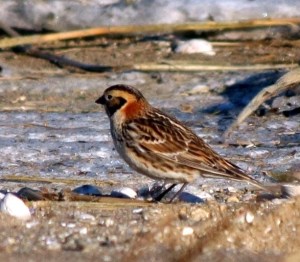
Lapland Longspur - Michael Ferrari

Lapland Longspur - Michael Ferrari

Highlight spectacle wise were the massive flock of Greater Scaup (4-5000?) that were flying up the sound eastwards. I was using their primary pattern to identify them (note in this comparrison illustration the way the white extends through the primaries on Greater Scaup) but as a general rule most scaup on the sound would tend to be Greater and birds on a pond or in a harbor would be Lesser (of course there are exceptions).

Bird wise the three LAPLAND LONGSPURS (or Lapland Buntings as they are known back in the old country) were my favorites. I love Longspurs and Snow Buntings, they just seem so tough the way they stick it out in the most inhospitable spots at the most inhospitable time of the year. Plus I must say I am more of a passerine fan than anything else, so these birds keep me going through the winter when there are few passerines gracing the state. Added to that we had 5 fairly uncooperative AMERICAN PIPITS (although one did provide better views when we went to retrieve cars from Long Beach) a flock of HORNED LARKS and 5 SNOW BUNTINGS to round off the regularly occurring pipits, larks, longspurs and buntings for the season.

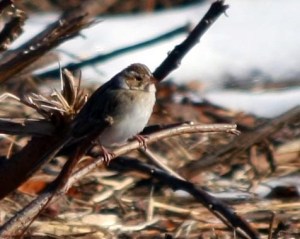
Probably the rarest bird of the trip and a State or life bird for many was the CLAY-COLORED SPARROW. Of course I am avowed sparrowphile, so it was nice to see this bird again (my lousy digiscoped pictures of this same bird in November here). A great looking bird and it performed fairly well, which was useful as it was accompanied by both Fields and Trees for a Spizella trifecta making picking it out from the group somewhat difficult. Added to the nice assortment of sparrows on the day was an Ipswich Savannah Sparrow. A great looking sparrow which made a nice comparison to the common or garden Savannah that we had over at the Gun Club.

Clay-colored Sparrow - Michael Ferrari

Clay-colored Sparrow - Michael Ferrari

I was also talking on the trip about this great little part of the Birdlife International website (which is worth an explore in and of itself) which has species fact sheets for all of the birds in the world (here). Out of interest I looked up the rarest bird I have ever seen – Black-breasted Puffleg (see awful picture from last July in Ecuador below) and here is the species sheet for that bird. I am currently trying to arrange a trip to Ecuador to go back and see this beautiful and rare bird (details to come soon on my trips and tours section).

Black-breasted Puffleg - Luke Tiller

Black-breasted Puffleg - Luke Tiller

Trip List- 50 Species

Great Blue Heron, Black-crowned Night Heron, Mute Swan, Canada Goose, Brant, American Black Duck, Mallard, Gadwall, American Wigeon, Canvasback, Greater Scaup, Long-tailed Duck, Common Goldeneye, Bufflehead, Red-breasted Merganser, Hooded Merganser,  Red-tailed hawk, Sanderling, Dunlin, Ring-billed Gull, Herring Gull, Great Black-backed Gull, Mourning Dove, Belted Kingfisher, Downy Woodpecker, Horned Lark,  AMERICAN PIPIT, Black-capped Chickadee, Tufted Titmouse, Carolina Wren, American Robin, Northern Mockingbird, Blue Jay, American Crow, Northern Cardinal, American Goldfinch, House Finch, CLAY-COLORED SPARROW, Field Sparrow,  American Tree Sparrow, White-throated Sparrow, Song Sparrow,  ‘Ipswich’ Savannah Sparrow, Savannah Sparrow, DE Junco, LAPLAND LONGSPUR, SNOW BUNTING, Red-winged Blackbird, European Starling, House Sparrow


Birding Bridgeport & Afternoon BGBY

3 01 2009
Bonaparte's Gull - Captains Cove

Bonaparte's Gull - Captains Cove

CAR

Popped out this morning to do some birding with Tina Green, Penny Solum and Sara Zagorski in Fairfield and Bridgeport. Results on the day were kind of mixed with no luck on the Snowy Owl or the gull flocks at Seaside Park but we did do nicely at the  Captains Cove in Bridgeport. Highlights there included a pair of fantastic NORTHERN PINTAIL (the hen is really just exquisite in my opinion and the drake is no slouch in the looks department either). We also managed to locate  a few LESSER SCAUP, PEREGRINE FALCON and a couple of BONAPARTE”S GULLS (which are named for Charles Lucien Bonaparte not his slightly more famous uncle Napolean).The only other real birds of note were a couple of AMERICAN PIPITS at Ash Creek.

Also a little note to people searching for Rough-legged Hawks, just because you have a hawk hanging in one spot don’t immediately assume it’s a Rough-legged, we had at least two Red-tails ‘kiting’ on the day which gave a very good impression of being ‘hovering’ Rough-leggeds. Hovering is a good clue to picking up Rough-leggeds, as is their propensity to sit right on the tippy-top of trees (they use these slender branches due to a small talon size and always look slightly humorous to me precariously perched on these thin branches) but confirm some field marks to be sure.

BGBY

After getting home and making a couple of essential phone calls I popped out for a bit of ‘bigbying’. Perhaps one shouldn’t be allowed to bigby on the same day that one has been out in the car (a moral conundrum for me to contemplate)?

I tried a little secret area just up my road and was thrilled to have it pay off in a big way. First I picked up on the little two noted chip of a WINTER WREN and it greeted me with some jaunty scolding. After that I picked up a scolding Titmouse and as I hiked up the slope to investigate the cause of its ire, a BARRED OWL, flopped out of the Hemlock stand that the Titmouse was in. The Owl sat out on the branch of a deciduous tree for a good 15 minutes and soon became oblivious to my presence – what a treat! To round off the brief bigby walk I also added a Hairy Woodpecker. Three new species for the list – not bad for a quick stroll.  Add that to the PINE SISKINS  in the birches in the yard at about 6:45am and it was another fine bigby days work. Still no Blue Jays though!


BGBY – Day 2 and amusing newspaper error

2 01 2009

BGBY

The early morning BGBY walk managed to net me a few nice additional species, although my feeders were devoid of birds today it seemed (I am losing the feeder war with my neighbor!) Highlight for the day were a couple of beautiful Red-shouldered Hawks – one of which was still asleep it seemed sitting on the cable wires right over Route 57. I walked right underneath the hawk and it never moved a muscle (no camera on the walk though – typical!). The Northern Flicker was a refreshing burst of bright color on an otherwise dull gray morning and the Hermit Thrush a nice surprise in with a load of Bluebirds up on the corner of Indian Hill. It seems like a bumper year for Bluebirds this year – which is never a bad thing.

BGBY additions for the day:

Red-shouldered Hawk, Herring Gull, Rock Pigeon, Northern Flicker, Cedar Waxwing, Hermit Thrush, House Sparrow

30 Species total and still no Blue Jay!!!!!!

Newspaper Story

A great news story in the English Daily Mail newspaper about how a woman went all the way to Norway to see Snow Buntings and didn’t see them and then found one at her feeder back home in England. A great story apart from the obvious error – as many of you here know Snow Buntings don’t come to feeders – the bird in the picture is a leucistic Chaffinch (a common yard bird) – oops! Out of interest Snow Buntings do occur every year in the UK but usually, as they do here, on windswept beaches – particulalrly in Norfolk!