This ones for all the ladies out there…

18 02 2009
leucard600

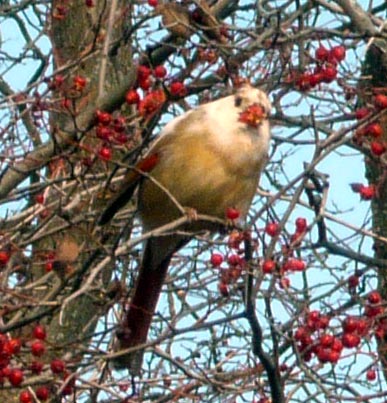
Leucistic Northern Cardinal - James Van Acker

After the interesting gynandromorph and leucistic Cardinal pictures (see above) on my blog recently and my mention that both male and female Northern Cardinals sing, my wife got in on the act and sent me this interesting article about Cardinal vocalizations (here). Appears that the old male Cardinals aren’t the quickest on the uptake when it comes to learning songs. In fact they lag rather noticeably behind their female counterparts in learning smarts. I have the feeling that my wife was trying to hint at some general inference here! Anyway an interesting piece of research about a common backyard bird.  The Science Daily Website also has a host of other interesting articles about bird song, animal intelligence etc and is well worth a perusal.


Sunrise Birding Walk – Feb 15

18 02 2009

Another fun day out on the local walk. I arrived at Sherwood Island to hear the group declaring that there was a hawk stuck in the tree in the parking lot and asking whether we should get on the phone to a rehab specialist that I know. I could see the hawk was flapping around, but as I swung my scope into action to see what exactly the hawk was caught on, I realized it wasn’t caught on anything but rather was trying to get at something in a hole in the tree.

The Red-shouldered Hawk was flapping around the hole trying to get into it with his talons and then stopping every now and then to appraise the situation. It was amazing to watch and as the bird peered into the darkness, moving it’s head side to side to better appraise how to deal with the problem, it’s easy to see how they mold the actions of dinosaurs in movies like Jurassic Park when you see that kind of behavior. Eventually the bird lunged in and for a while it had the squirrels tail and was trying to yank him out using it’s beak ,but without much luck. As with most raptors the real strength lies in their talons and it eventually gave up on the meal and departed.

When I told my wife the story when I got home she said that she felt happy for the squirrel but kind of sad for the hawk as it was going hungry. I knew how she felt even though I am not a huge squirrel fan (especially when they wreck my feeders). It was an amazing episode to watch though and one of those incidents that you just feel lucky to stumble on.

It made me think of an incident a few years back at Sherwood when I had hiked in early to to be there at dawn and had seen a skunk scuttling back towards its daytime den. Spotting the mammal crossing open ground, one of the young resident Red-tails had noticed the seemingly easy meal and was swooping in for the kill. As I watched it close in on the skunk the skunk turned and gave it an almighty spray from its scent glands and the hawk visibly stalled in its attack path. The hawk recovered fairly quickly and renewed it’s attack but was met with another accurate burst and again it reeled backwards, after a third squirt the hawk quite obviously realized it had bitten off more than it could chew and decided to go look for a slightly more defenseless meal, at which point the skunk headed on it’s merry way home.  Apparently Great Horned Owls and Red-tails are the skunks most common predators. I would guess that the irritant factor (which can even cause temporary blindness) of the well directed spray was enough to deter this hawk. It’s these kind of fascinating things that you feel blessed to see when you are out in nature.

The rest of the walk was fun but with nothing Earth shattering in the way of birds. We had a couple of chipping Yellow-rumped Warblers that were new arrivals at Sherwood but probably weren’t early migrants but lingering fall birds that had wandered in from somewhere. The blackbirds however were migrating and those first flocks of Grackles and Red-winged Blackbirds are to me the first real gauge of the beginning of spring. It’s a great moment when you get those first flocks winging their way north and as they move during the day, unlike many of their passerine brethren, they are a real visual sign of an exciting spring to come. Other highlights on the day were an adult Bald Eagle that I think Mike and Katie spotted first at Southport Beach and the regular (but still uncommon in North America) Lesser Black-backed Gull at Burying Hill Beach.

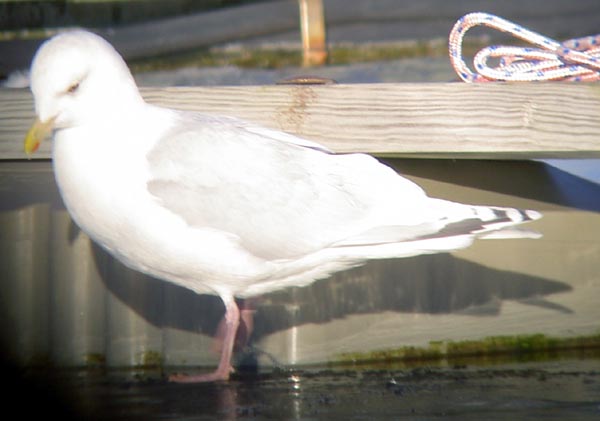
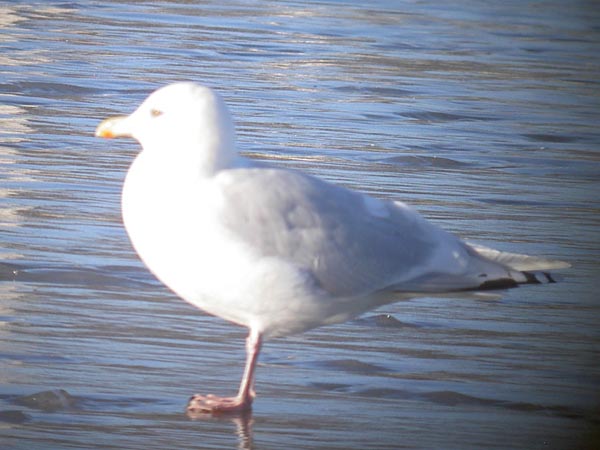
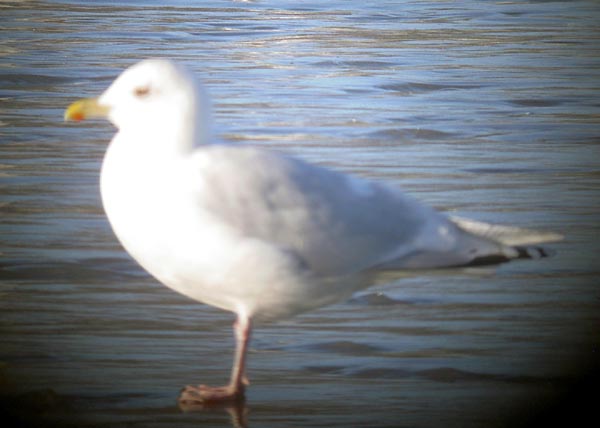
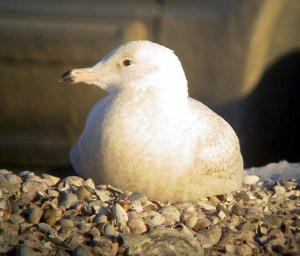
Post walk I stumbled upon a singing Ruby-crowned Kinglet, a somewhat unexpected sound on a still cold February Day (listen here) and an adult Kumlien’s (Iceland) Gull at Compo Beach in Westport (see dreadful pictures below). It was cool to see this adult as I haven’t seen that many previously. Obviously with gulls structure plays a key element in IDing the birds and this one has the typical dove like rounded head, cute expression as well as the small bill and longish primary projection.

Trip List

Horned Grebe, Red-throated Loon, Common Loon, Mute Swan, Canada Goose, Brant, American Black Duck, American Wigeon, Gadwall, Mallard, Common Goldeneye, Hooded Merganser, Red-breasted Merganser, Long-tailed Duck, Turkey Vulture, Red-tailed Hawk, Red-shouldered Hawk, Bald Eagle, Herring Gull, Great Black-backed Gull, Lesser Black-backed Gull, Ring-billed Gull, Rock Pigeon, Mourning Dove, Downy Woodpecker, Red-bellied Woodpecker, Black-capped Chickadee, Tufted Titmouse, Carolina Wren, American Robin, Blue Jay, American Crow, Northern Cardinal, Yellow-rumped Warbler, American Goldfinch, American Tree Sparrow, White-throated Sparrow, Song Sparrow, DE Junco, Common  Grackle, Red-winged Blackbird, European Starling, House Sparrow


Latest Sunrise News

13 02 2009

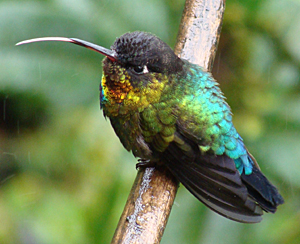
Fiery Throated Hummingbird - Gina Nichol

Fiery Throated Hummingbird - Gina Nichol

You can now read all the latest news from Sunrise Birding on the website (here).This includes Gina’s latest trip notes from Costa Rica (look out for the 2010 trips – one of which includes yours truly as co-leader), new trip reports, upcoming tours (including a couple with late availability) and details of Gina’s talk on hummingbirds at the COA General Meeting (sign up here).


Hudson River Eagles Trip – Feb 8th

11 02 2009

On Sunday my ‘local’ walk took one of our few forays out of Connecticut for a trip over to the Hudson River looking ostensibly for both eagles and owls. I had done a little scouting on Friday and had been happy to find a host of Eagles but to my horror the roosting site of some of the sought after owls had a gaggle of workmen hammering away at something underneath them. Seeing me peer longingly into the pines one of the workmen chirped up with a ‘not here today’ obviously knowing what I was searching for. I tempered my reply avoiding the ‘you don’t say’ and just said thanks and moved on, praying that they would have returned by the Sunday.

Unfortunately for the sake of the tour the owls had obviously had enough and although we found plenty of pellets, whitewash and other roosting owl detritus from two different species we struck out on owls for the day. It’s hard not to feel a little disappointment as a tour leader when a place that you know can be so wonderful doesn’t quite meet up with your expectations for the day, although I always try to remember what a good friend of mine always says: ‘if you want guaranteed bird sightings you are better off going to the zoo.’

We did however do fairly nicely when it came to Eagles on the day, finding birds at Croton-Harmon Station soaring around the now open water. Thanks to a big thaw and temperatures in the high 40’s on the day things were quite different than Friday although honestly it was a blessed relief after so many frigid tours of late.

I have lead tours on the Connecticut River and still volunteer for the CAS Eagle Festival (sadly canceled this year) and have seen multitudes of Bald Eagles in that time. However it never ceases to give me a thrill seeing these magnificent birds. What is best about seeing all of these birds is knowing that with the help of conservationists and environmentalists we have managed to drag this species back from the brink of destruction after the dark days of DDT poisoning. Best of all is seeing all the young birds that will go on to secure the future generations of this species (I remember talking to old hands who said the most depressing thing in the late 60’s and early 70’s was seeing how few young birds were coming through each year.)

We then moved on to Croton Point Park proper . The park is the site of an old landfill (now grassland) and juts out into the mighty Hudson. The scenery there is beautiful and the birding can be sublime (in previous years I have been there when Short-eared Owls in large numbers have been actively hunting the site by day). Things were a little quieter than I had hoped but we still managed good looks at a number of Harriers which we discussed identifying to age and sex. Highlight was a particularly co-operative Grey Ghost, probably one of the more beautiful and graceful raptors in North America. Unfortunately no sign of a Roughie which can often be found here.

Exploring the park a little further we stumbled upon a large mixed flock of finches, but as hard as we searched we couldn’t find an Redpoll amongst them. Other highlights were 4 or 5 eagles sat on the ice almost playing with a few large fish that had washed up out of the river. I guess they had been feeding pretty well recently as these situations often lead to some scrapping. We talked about aging the eagles (which can usually be safely aged although it is a little more complicated than some texts suggest) and when they reach sexual maturity (4 or 5 years). The other interest sighting of the day was the huge rafts of Common Mergansers sitting out on the Hudson, staging up for their flight north. There were at least a couple of groups of these glorious birds numbering in the hundreds and somewhat surprisingly almost all were males (probably trying to get a head start on the trip north to set up their territories).

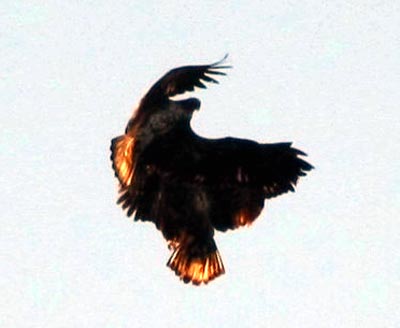
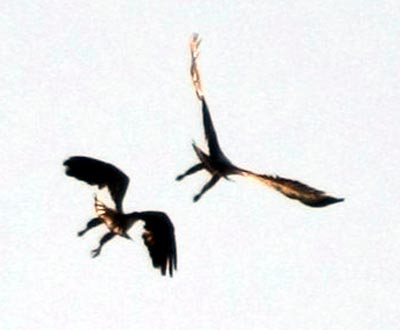
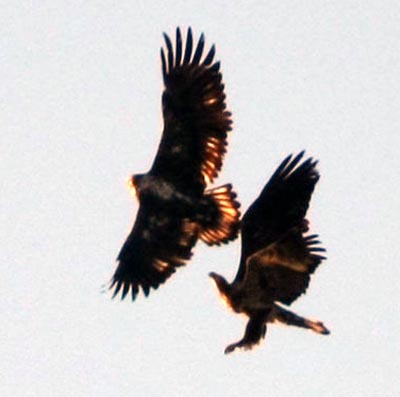
To end the day we stopped over at George’s Island. This is a well known eagle roost and towards sundown one is almost guaranteed good sightings and good numbers of roosting Bald Eagles. We arrived  little early to find one adult bird sitting in one of the trees but we were not waiting long before there were five birds all in the air at one time. As birds flew in and began to settle in for the night two young birds put on quite the show – perhaps practicing their courting maneuvers for future years (see the atmospheric shots from Michael below), or maybe just having a little fun for the day. This sky dance was the perfect end to the day and although there were still Eagles drifting in as we left, everyone was desperate to go grab a warming bowl of soup and a cup of Coffee. We ended the day back at Croton more in hope than expectation that some owls might put on a dusk appearance but although the scene was set perfectly for them with a beautiful wintery full moon they just weren’t playing ball today.

Still a fun day out with lots of great people and it was great to catch up with some old friends and introduce some new ones to the site. The eagles were as fantastic as ever, although the supporting cast could have been better.  Next year it’ll be awesome there I am sure.


Big January – Additional Photo’s

11 02 2009

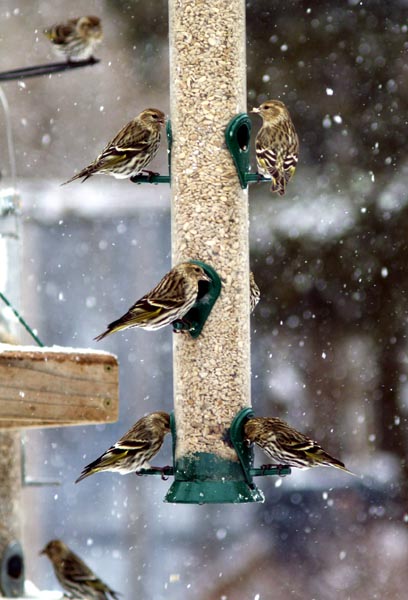
It seems like the story of this years Big January was the story of winter finches rather than rarities. It’s been a decent couple of years for them with Pine Grosbeaks, Redpolls, Red Crossbills and Bohemian Waxwings evident last winter and this winter the tale has been of Pine Siskins (sometimes in their hundreds at feeders), White-winged Crossbills and a smattering of Redpolls (I even got lucky enough to add them to my yard list).

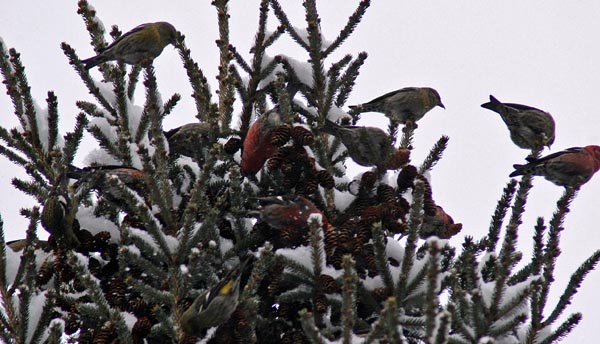
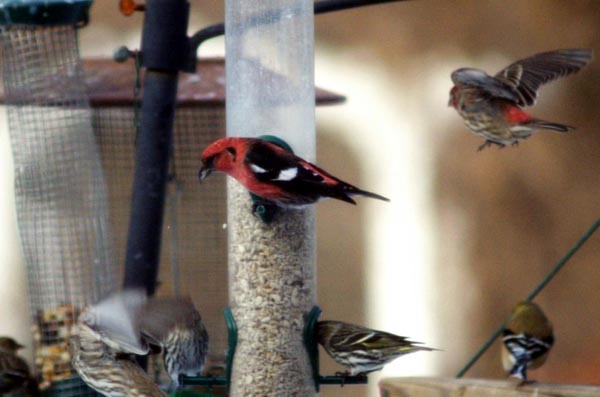
The first sign of Pine Siskins were massive movements tallied at hawk watches across the state in fall, however it appeared as if a second major push occurred in winter, bringing many thousands of these birds into the state and onto peoples feeders. The other major flight this year was of White-winged Crossbills. Although much harder to come across these birds have been reported up and down the state and have probably been no easier to find than at Sherwood Island State Park (where Renee took the attached photo).

It was cool to stumble on these flocks myself and to get to see them happily feeding and chirruping away to each other – like many of their northern brethren they seem to often have little fear of your average birder and on one occasion at Sherwood they allowed me such close approach that I could have almost just reached out to grab one.

Annette sent me this cool picture of a Crossbill at her feeder, a pretty rare occurrence for a bird that tends not to regularly frequent them (although I have seen a few feeder pictures of this species this year). My guess would be that lone birds are more likely to approach a feeder especially if they have joined a mixed flock that is using them.


Gynandromorph Birds

3 02 2009

My friend Jim Meinhold (of Varied Thrush fame) sent me this great blog article and I thought I’d crib something from it just in case no-one had seen these amazing images yet.

They are of a gynandromorph bird (yes I had to look it up in wikipedia as well). Basically it’s an animal which displays both male and female characteristics and in rare occasions, as with this Cardinal, the animal can display bilateral gynandromorphism where one side shows male characteristics and the other female.

A quick search on the web for this rare phenomenon produced these pictures of a gynandromorph Evening Grosbeak skin. The Powdermill Website also has some cool pictures of Rose Breasted Grosbeak (more on their website  here)  and an Eastern Towhee showing similar characteristics (more here). I also found a couple of examples of cage birds.

Pretty interesting stuff and cool pictures. I just had to share!


Bird Phone

28 01 2009
eNature - Swainson's Thrush

eNature - Swainson's Thrush

My friend Chrissy sent me a link to a site where you can get bird song ringtones for your phone. There are plenty of sites out there offering this feature but the eNature one was the only one I could find that was letting you use them for free. Other prices seemed to range from $2.49-$2.99.

I notice on the eNature front page that Barn Owl was a favorite. I find that a little hard to believe, although I would think it would certainly make you want to make you pick up your phone pretty quickly.  For me the Swainsons Thrush would be hard to beat although you might end up just wanting to listen to the song more than you want to pick  up the call! I haven’t tried one out yet but i’ll update when I do. Not sure why Audubon or someone doesn’t offer this as a service – might be a nice little fundraiser (I’d be much happier paying a non-profit for this service).


More Owl!

28 01 2009

Northern Hawk Owl and Vole - AJ Hand

Northern Hawk Owl and Vole - AJ Hand

AJ Hand, who last weeks owl prowl participants got to meet in the flesh, sent me this stunning picture of the Northern Hawk Owl from New Hampshire. Brilliantly atmospheric and fantastic timing from the photography aspect. Here is the great story that surrounds the shot in AJ’s own words:

“We were shooting this Hawk Owl on Monday, as he sat perched high in a tree,  alertly scanning the countryside. Not long after we got set up, he started cocking his head left and right, and bobbing up and down. Suddenly he swooped down–right at us–and crashed into the snow not 6 feet away. After a brief struggle he popped up with this vole and flew to this perch where he ripped off the head and ate that, then quickly swallowed the rest, neck first . After we got shots of him chowing down,we checked out the murder scene.

It turns out, the vole had been crawling through his subnivean tunnel and came to a spot where it cut across a deep snowmobile track. To continue his journey,  he had to pop out of the tunnel, get across 16 inches of packed snow and reenter the tunnel on the other side of the track. It looked like the owl got him before he even started across, just as he was just peeking out and evaluating the situation. Never had a chance!”


Owl Prowl – Additional Photographs

26 01 2009

Here are a couple of great additional pictures from the Owl Prowl taken by Steve Ballentine on the day.  Thanks again for sharing them Steve.


Sunrise Bird Walk – Daytime Owl Prowl Jan 24

25 01 2009

What no owl? - Luke Tiller

What no owl? - Luke Tiller

Another weekend, another wonderful birding trip. This was my first attempt to run an owl prowl for Sunrise and it turned out to be a very successful day (even if I say so myself). Part of the problem with owls is that personally I believe one needs to be almost hyper sensitive of their needs as they can ill afford to be expending extra energy. Raptors have a hard enough time in winter as it is and birds that are roosting during the day should be left as undisturbed as possible. At the same time it is nice to show people these birds as they are highly appreciated and often they are difficult to find even when you know where and how to look (part of the trip was an attempt to help people decide where to look for and what to look for to find their own owls in the future).

In the event we managed to get good looks at 3 species of owl and best of all it was all done by a very respectful and appreciative group.  I specifically picked public places to look, where the appearance of a few birders wouldn’t make any real difference to the birds usual routine. Highlights of the trip were obviously LONG-EARED OWL, GREAT HORNED OWL and BARRED OWL. The Barred  in particular gave us a great demonstration of how hard these birds can be to find even when you know where they are, as it finally revealed itself to us after we had walked underneath it a couple of times (as had numerous dog walkers, dogs, hikers etc).

There is something still kind of mystical and magical about owls and I love to see them although I do it  rarely (doing some scouting I found a few other owls but most were too flighty, in too vulnerable positions, or just simply too far from the route to share with a group). Sometimes I think the impression is on CTbirds is that there is an in clique of birders that share these sort of sightings, but in my experience there really isn’t. I generally do not share any owls I find and at the same time I pretty much expect the same from my birding friends. Even when I get a tip off about an owl I generally don’t follow up on it as I don’t want to disturb the bird, and for me the real thrill is finding ones own owls. That moment you suddenly stumble on one is quite unbelievable.

I remember the first time I found a Saw-whet, I looked under a tree and found some pellets and expected as usual to look up in the tree and find it empty but to my surprise there the a bird sat winking down at me. A fantastic experience that will stay with me forever. It is that experience that you want to share with people, but at the same time you are always drawn in the other direction of leaving the bird alone to just get on with its life without disturbance.

On the trip I also mentioned the dangers of getting too close to owls especially when they are nesting. Highlighting this was British bird photographer Eric Hosking who famously lost an eye whilst trying to photograph a Tawny Owl (a member of the Strix family which includes Barred, Spotted and Great Grey in the US). He basically became famous after that attack and his autobiography was amusingly titled ‘An Eye for a Bird’.

Of course checking pine stands in winter you are always likely to turn up some other goodies. Highlights included a small flock of WHITE-WINGED CROSSBILLS, PINE SISKINS – almost ubiquitous this winter (I checked online and it is estimated there are as many Pine Siskins in the US as there are Goldfinches so it’s no wonder they appear to be so many in these big incursion years), BROWN CREEPER, MERLIN, 31 BOAT-TAILED GRACKLES and GLAUCOUS GULL (obviously not in a Pine Stand!!!).

A nice day out shared with old friends, some new faces and some amazing birds. Saturdays really don’t come much better. Thanks to everyone for coming and to Shaun Martin and AJ Hand particularly with help locating a couple of these hard to find birds.

Trip List

Mute Swan, Canada Goose, Brant, American Black Duck, Mallard, Common Goldeneye, Hooded Merganser, Red-tailed Hawk, Merlin, Turkey, Dunlin, Herring Gull, Great Black-backed Gull, Glaucous Gull, Ring-billed Gull, Rock Pigeon, Mourning Dove, Great Horned Owl, Barred Owl, Long-eared Owl, Downy Woodpecker, Horned Lark, Brown Creeper, Black-capped Chickadee, Tufted Titmouse, Carolina Wren, Golden-crowned Kinglet, American Robin, Blue Jay, American Crow, Northern Cardinal, American Goldfinch, Pine Siskin House Finch, American Tree Sparrow, White-throated Sparrow, Song Sparrow, DE Junco, Boat-tailed Grackle, White-winged Crossbill, European Starling, House Sparrow